Water Cleanup in Thousand Oaks
24/7 water cleanup in Thousand Oaks, CA. IICRC-certified, insurance billing accepted. Call (805) 290-7292.
Our IICRC-certified technicians are dispatched from our Ventura, CA headquarters and are typically on-site in Thousand Oaks within 60 minutes of your call.
Thousand Oaks sits in a Mediterranean climate that swings hard between dry summers and wet winters — and when the rains arrive after months of parched soil, the ground can’t absorb fast enough. Water finds its way into garages, crawl spaces, and finished basements before a homeowner even realizes the storm drain at the curb is backing up. Whether it’s a burst supply line in a tract home off the 101 or a slow roof leak that finally soaked through insulation during a January system, California Restoration West responds around the clock to stop the damage and start drying.
Why Thousand Oaks Properties See Water Damage Differently
Ventura County’s inland valleys, including Thousand Oaks, experience a phenomenon locals call the “clay cap” problem. Much of the city sits on expansive clay soils that shift with moisture content. When water saturates those soils, hydrostatic pressure builds against slab foundations and stem walls — pushing moisture through hairline cracks that were invisible before the rain. Homes built in the 1970s and 1980s, which make up a large portion of the housing stock in this part of the Conejo Valley, often have original copper or galvanized supply lines that are now at or past their service life. A pinhole leak behind a kitchen cabinet can run undetected for weeks, and by the time the smell of mildew signals a problem, the subfloor and lower wall cavities are already saturated.
Additionally, many properties here are served by California American Water, whose main shutoffs are sometimes located at the street in tight landscaped parkways — not always easy to access quickly during a plumbing failure. Knowing where your meter shutoff is before an emergency matters.
Our Water Cleanup Process in Thousand Oaks
When we arrive, the first priority is stopping the source if it hasn’t been addressed. From there, the process follows the IICRC S500 standard for water damage restoration — the same framework used by carriers and adjusters to validate the scope of work.
Moisture mapping comes first. We use thermal imaging cameras and calibrated moisture meters to find water that has migrated behind walls, under flooring, and into ceiling cavities. In Thousand Oaks homes with stucco exteriors, water that enters around window frames can travel laterally inside the wall assembly much farther than the visible wet spot suggests.
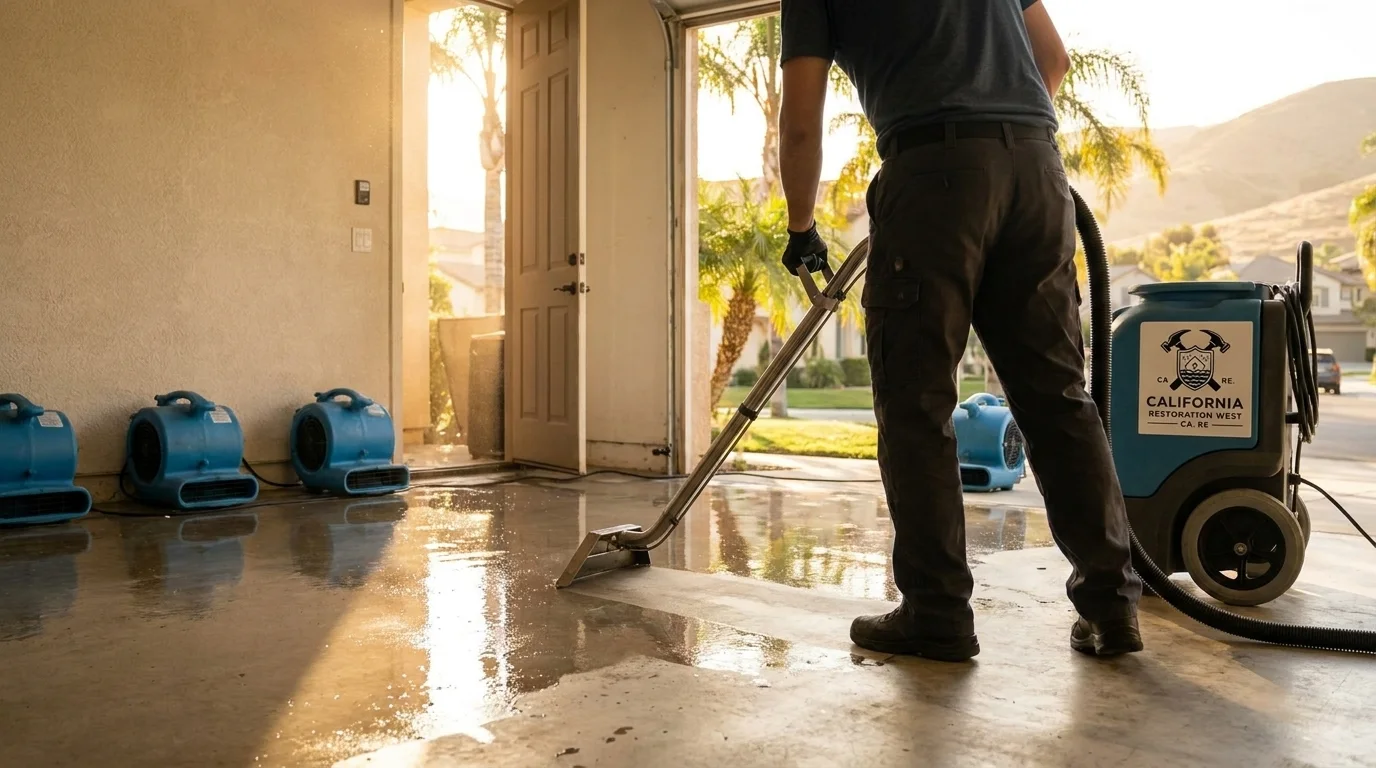
Standing water removal uses truck-mounted and portable extraction units capable of pulling hundreds of gallons from carpet, pad, and hard flooring. We remove saturated materials — pad, drywall, insulation — that cannot be dried in place without risking secondary mold growth.
Structural drying follows with industrial air movers and desiccant or refrigerant dehumidifiers sized to the affected area. Drying logs are kept daily and shared with your insurance adjuster.
Clearance readings confirm that all structural materials have returned to acceptable moisture content before any reconstruction begins.
Reaching Thousand Oaks from Ventura
California Restoration West is based in Ventura, and the primary route to Thousand Oaks is the US-101 East through the Conejo Grade — a stretch that can add time during peak commute hours or after a significant storm when traffic backs up near the Camarillo grade. Because we operate 24/7, most emergency calls reach us outside peak traffic windows, and our crews can be moving toward the Conejo Valley quickly. For properties deeper into the city — toward the Wildwood area or the neighborhoods off Lynn Road — we factor in local surface street conditions when dispatching.
Insurance Coordination for Thousand Oaks Claims
Most standard homeowner policies in California cover sudden and accidental water damage — a burst pipe, an appliance failure, an overflow — but not gradual leaks or flood events tied to rising surface water. That distinction matters when we document the loss. Our team photographs affected materials, records moisture readings at every measurement point, and prepares a scope of work formatted to the line-item standards carriers expect. We bill most major insurance carriers directly so you are not fronting the full restoration cost while waiting for a claim to settle.
If your property is governed by an HOA — common in many of the planned communities throughout the Conejo Valley — we can communicate directly with your association’s property manager about access requirements, common-area involvement, and any documentation the HOA needs before work begins.
Local Note
Homes in Thousand Oaks with tile roofs — a dominant style throughout the Conejo Valley — develop water intrusion patterns that are easy to misread. A cracked or slipped tile lets water into the underlayment, which then channels it horizontally along the roof deck before it finds a penetration point and drops into the attic or wall cavity. By the time a water stain appears on a ceiling, the entry point is often several feet away from where the damage shows. We probe attic insulation and check the roof deck from below before assuming a ceiling stain tells the whole story.
If you are dealing with standing water, soaked flooring, or a leak that has been running longer than you realized, call California Restoration West at (805) 290-7292. We serve Thousand Oaks and the surrounding Conejo Valley 24 hours a day, and we will walk you through next steps before we even arrive on site.
Water Cleanup in Thousand Oaks: Service Coverage
Frequently Asked Questions
How fast can you arrive for water cleanup in Thousand Oaks?
How quickly can California Restoration West reach Thousand Oaks for a water emergency?
My Thousand Oaks home is on a slab foundation — does that change how water cleanup works?
Does Thousand Oaks' dry-then-wet climate affect how long structural drying takes?
My property is in a Conejo Valley HOA community — do you handle coordination with the association during water cleanup?
What materials in a Thousand Oaks home typically cannot be dried in place after water damage?
Will my homeowners insurance cover water cleanup in Thousand Oaks?
Water Cleanup response in Thousand Oaks
Most Thousand Oaks calls see a technician on-site within 60 minutes from our Ventura headquarters.