
Mold Remediation in Thousand Oaks
24/7 mold remediation in Thousand Oaks, CA. IICRC-certified, insurance billing accepted. Call (805) 290-7292.
Our IICRC-certified technicians are dispatched from our Ventura, CA headquarters and are typically on-site in Thousand Oaks within 60 minutes of your call.
Thousand Oaks sits in a Mediterranean climate that most homeowners associate with dry summers and mild winters, not mold. But the city’s position between the Santa Monica Mountains and the Conejo Valley creates a pattern of marine layer intrusion, seasonal fog, and periodic heavy rainfall that leaves moisture trapped in walls, crawl spaces, and attic cavities long after the weather clears. When that hidden dampness meets the region’s warm interior temperatures, mold colonization can begin within 24 to 48 hours of a leak or flood event, often before a homeowner notices anything beyond a faint musty smell.
Why Thousand Oaks Properties See Mold Issues
The Conejo Valley’s geography plays a larger role in mold risk than most residents expect. Fog and marine air push inland from the coast regularly, especially in late spring and early fall, keeping relative humidity elevated inside homes even during periods without rain. Homes with inadequate attic ventilation trap that moisture against roof sheathing and insulation, and crawl spaces over the clay-heavy soils common throughout the valley hold ground moisture year-round.
Building stock matters here too. Much of Thousand Oaks developed rapidly through the 1960s, 1970s, and 1980s, and homes from that era often feature original fiberglass batt insulation, single-pane windows, and vapor barriers that were either improperly installed or have degraded over decades. These conditions create microclimates inside wall cavities where mold can establish itself quietly, sometimes for months, before it becomes visible or detectable by smell.
Our Mold Remediation Process in Thousand Oaks
Every mold project begins with a thorough inspection that goes beyond what’s visible on the surface. Moisture meters, thermal imaging, and air sampling help locate affected areas behind drywall, under flooring, and inside HVAC cavities, the places where Thousand Oaks homes most commonly harbor hidden growth after a slow plumbing leak or roof intrusion.
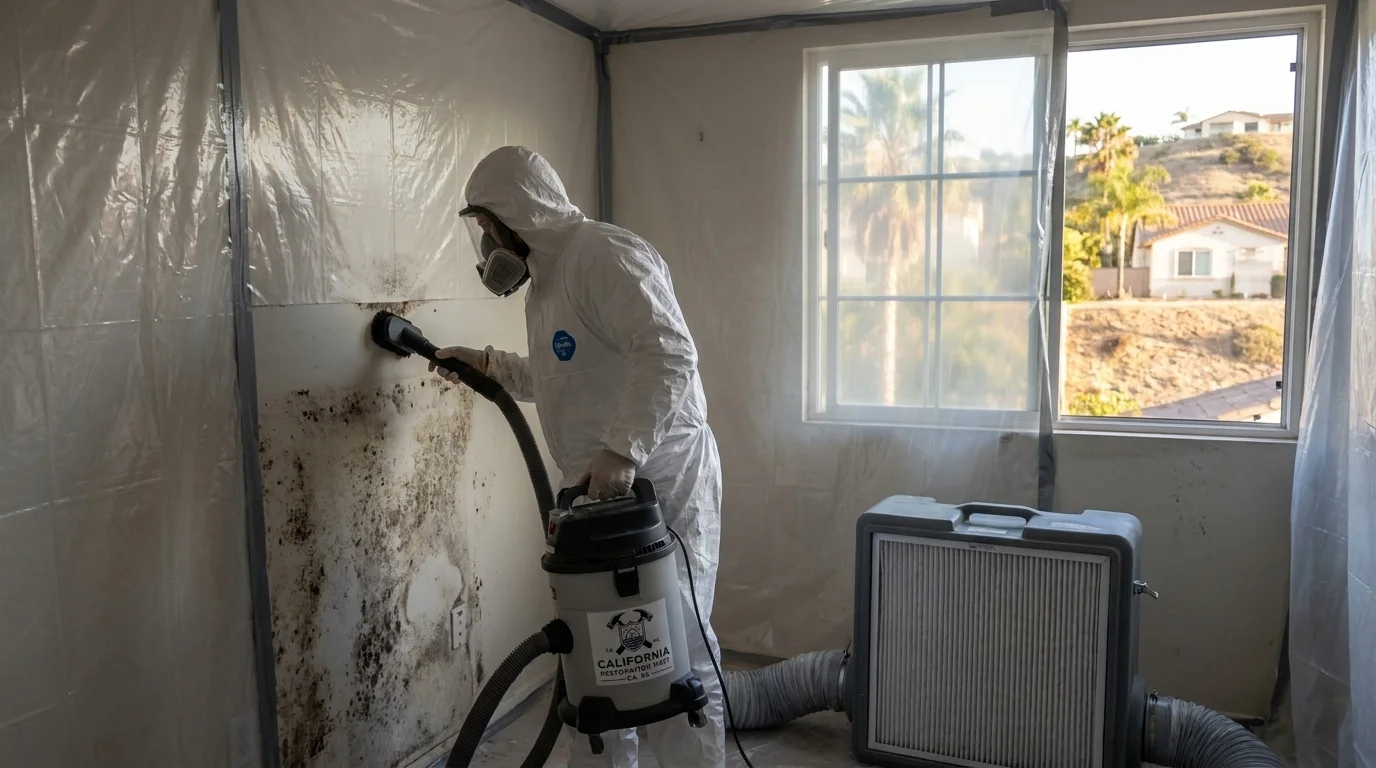
Once the scope is defined, the crew establishes containment using negative air pressure and 6-mil poly barriers to prevent spores from migrating to unaffected areas of the home. Affected materials, drywall, insulation, wood framing, are removed and bagged for disposal per California Department of Public Health guidelines. The structural surfaces that remain are treated and dried to verified moisture levels before any reconstruction begins. The team holds IICRC AMRT (Applied Microbial Remediation Technician) certification, and all work is performed by OSHA-trained technicians.
Reaching Thousand Oaks from Ventura
California Restoration West is based in Ventura, and the US-101 corridor connects the two cities directly. The route is straightforward under normal conditions, and the team is available around the clock, 24/7, for mold assessments and emergency containment calls. During peak commute hours, the stretch through Camarillo and Newbury Park can add time, so the dispatch team accounts for that when coordinating arrival windows and communicates estimated timing clearly.
Thousand Oaks Insurance and HOA Coordination
Many Thousand Oaks neighborhoods, particularly planned communities in the western and southern portions of the city, are governed by homeowners associations with specific requirements around contractor access, exterior staging, and documentation. Before work begins, the team confirms any HOA notification requirements and coordinates access for equipment and dumpsters accordingly.
On the insurance side, mold remediation coverage in California varies significantly depending on whether the growth is tied to a sudden covered peril (like a burst pipe) or long-term conditions. The crew documents the loss thoroughly, moisture readings, photographs, material inventories, and scope notes, in a format that supports your adjuster’s review regardless of which carrier holds your policy.
Local Note
Homes in the Conejo Valley built during the tract-home expansion of the late 1960s and 1970s frequently used a stucco-over-wood-frame exterior system that is highly susceptible to moisture intrusion when the original weep screed at the foundation line becomes blocked or damaged. Water that enters the wall cavity at the base of a stucco wall in this type of construction wicks upward through the wood framing rather than draining out, meaning the visible mold on interior drywall is often just the surface expression of a much larger column of contamination behind the wall. Identifying the entry point and correcting it is as important as the remediation itself; treating the mold without addressing the stucco intrusion guarantees a recurrence.
If you’re dealing with a musty smell, visible discoloration, or a recent water event at your Thousand Oaks property, the right next step is a proper inspection, not a wait-and-see approach. Call California Restoration West at (805) 290-7292 any time, day or night, to schedule an assessment and get a clear picture of what you’re dealing with before conditions worsen.
Serving Thousand Oaks from our Ventura headquarters — ★ 5.0 · 9 Google reviews
“Jimmy and his team were great to work with — professional, responsive, and did excellent work here in the Thousand Oaks/Conejo Valley area. Highly recommend them for anyone looking for reliable, quality service.” — Davis, November 2025Read our reviews on Google →
Mold Remediation in Thousand Oaks: Service Coverage
Frequently Asked Questions
How fast can you arrive for mold remediation in Thousand Oaks?
Does the marine layer and fog that rolls into Thousand Oaks actually cause mold inside homes?
How quickly can California Restoration West respond to a mold emergency in Thousand Oaks?
My Thousand Oaks home was built in the 1970s — does that affect how mold remediation is handled?
Will my Thousand Oaks HOA need to be notified before remediation work begins?
What does the mold containment process actually involve, and how long does it disrupt the home?
Will my homeowners insurance cover mold remediation in Thousand Oaks?
Watch: Mold Remediation in Thousand Oaks
Mold Remediation response in Thousand Oaks
Most Thousand Oaks calls see a technician on-site within 60 minutes from our Ventura headquarters.