
Mold Remediation in Ventura
24/7 mold remediation in Ventura and surrounding areas. IICRC-certified, insurance billing accepted. Call (805) 290-7292.
That musty smell behind the bathroom wall isn’t just unpleasant, it’s a signal that mold has already been colonizing for days, possibly weeks. Mold can begin growing on wet drywall, insulation, or wood framing within 24 to 48 hours of a moisture event, and by the time you can see discoloration or smell it in the air, the colony is almost certainly larger than what’s visible on the surface. Mold remediation isn’t cleaning, it’s a controlled, documented process designed to stop active growth, remove contaminated materials safely, and verify through air testing that the space is back to normal fungal ecology.
What mold remediation actually involves
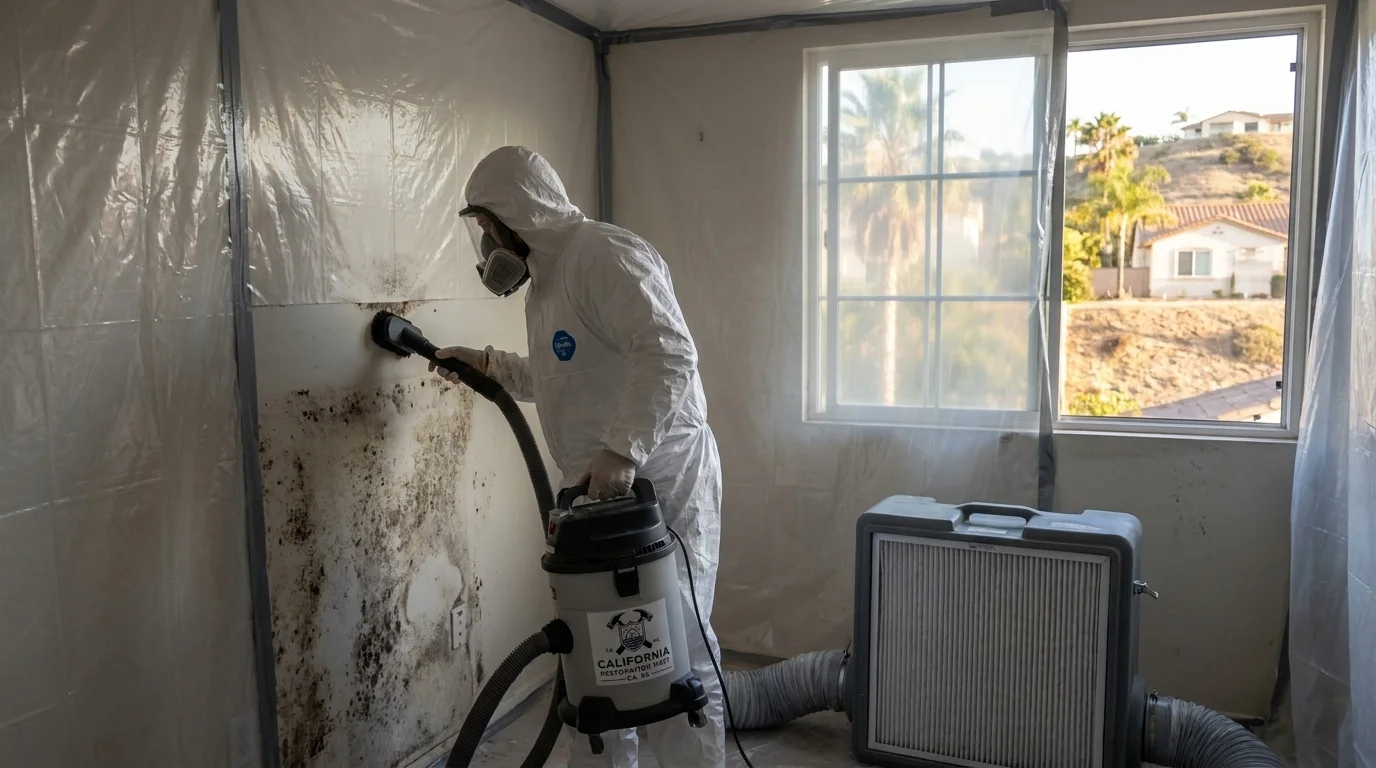
Mold remediation is not bleach and a scrub brush. Effective mold abatement requires physical containment of the affected area, negative air pressure to prevent spore migration to clean zones, HEPA-filtered air scrubbing, controlled demolition of materials that cannot be cleaned (typically porous materials like drywall and insulation), and post-remediation verification testing before containment is removed.
The equipment on a proper mold remediation job includes polyethylene containment barriers with zipper-entry airlocks, commercial-grade HEPA air scrubbers running continuously throughout the work, negative air machines exhausting filtered air to the exterior, and personal protective equipment rated for biological hazards. Surfaces that can be salvaged, framing lumber, concrete, tile, are treated with EPA-registered antimicrobial agents and physically abraded or HEPA-vacuumed before clearance testing.
Timeline depends heavily on the extent of growth and the materials involved. A single-room mold cleanup in a bathroom with contained moisture damage may take two to three days. A crawlspace with widespread growth across floor joists and subfloor, or an HVAC system with mold in the ductwork, can run a week or more before clearance testing confirms the work is complete.
The team holds IICRC AMRT (Applied Microbial Remediation Technician) certification, which means the work follows the IICRC S520 standard, the industry protocol that insurance adjusters and industrial hygienists use to evaluate whether a remediation was done correctly.
Our process
-
Moisture source identification and initial assessment. Mold is a symptom. Before containment goes up, we locate and document the moisture source, whether that’s a slow pipe leak behind a wall, condensation from an undersized HVAC system, or groundwater intrusion in a crawlspace. Remediating mold without addressing the source guarantees recurrence.
-
Containment and negative air pressure setup. Polyethylene barriers isolate the work area from the rest of the structure. Negative air machines create lower pressure inside the containment zone so that any disturbed spores move toward the filtration equipment, not toward your living space. HEPA air scrubbers run continuously from setup through final clearance.
-
Controlled demolition and mold removal. Porous materials with active mold growth, drywall, insulation, carpet, ceiling tile, are removed, double-bagged in 6-mil poly, and disposed of as regulated waste. Structural materials that can be retained are HEPA-vacuumed, wire-brushed or sanded where necessary, and treated with EPA-registered antimicrobials. All work is documented photographically for your insurance file.
-
HEPA cleaning and surface treatment. After demolition, every surface inside the containment zone is HEPA-vacuumed and wiped with antimicrobial solution, including framing, subfloor, mechanical equipment, and the containment barriers themselves before they come down. This step is frequently skipped or rushed on low-bid jobs, and it’s one of the first things a clearance tester will flag.
-
Post-remediation clearance testing. Before containment is removed, air samples and surface samples are collected, by a third-party industrial hygienist when the project scope warrants it, and compared against outdoor baseline samples. Clearance is confirmed only when spore counts inside the remediated area are consistent with normal outdoor fungal ecology. We do not declare a job complete based on visual inspection alone.
What separates a good mold remediation response from a bad one
The most common failure in mold remediation is inadequate containment, work performed without negative air pressure, or with containment barriers that don’t extend far enough to capture the full affected area. Disturbing an active mold colony in an open room aerosolizes millions of spores into HVAC systems and adjacent spaces, turning a localized problem into a whole-house one.
The second most common failure is stopping at the visible growth. Mold behind drywall routinely extends six to twelve inches beyond the visible stain on the paper face. Operators who cut only to the edge of the discoloration leave active growth in place. Proper remediation means cutting to clean, unaffected material and verifying with moisture readings that the remaining structure is dry.
Insurance adjusters and industrial hygienists reviewing a mold claim look for a few specific things: a written scope of work tied to the IICRC S520 standard, pre- and post-remediation air sampling results, photographic documentation of containment setup and material removal, and a clearance report signed by a qualified third party. Jobs that skip any of these steps frequently face claim disputes or require re-remediation at the homeowner’s expense.
Black mold remediation, work involving Stachybotrys chartarum, warrants particular attention to containment and personal protection. Stachybotrys is a slow-growing species typically found on materials that have been wet for an extended period, and its remediation follows the same S520 protocol as other mold species, with no shortcuts on containment or clearance verification.
What does mold remediation cost?
Typical mold remediation costs vary significantly based on the size of the affected area, the materials involved, and whether the moisture source requires repair before or during remediation. Most homeowners pay somewhere in the ranges below for common scenarios, these are industry-typical figures, not California Restoration West quotes.
| Scenario | Typical industry range |
|---|---|
| Single bathroom, surface mold on tile and grout | $500 – $1,500 |
| Single room, drywall and insulation removal required | $1,500 – $4,000 |
| Crawlspace mold across floor joists and subfloor | $3,000 – $10,000 |
| Attic mold from roof leak or inadequate ventilation | $2,500 – $8,000 |
| HVAC system mold contamination with duct cleaning | $3,000 – $10,000+ |
| Whole-house or multi-room remediation | $10,000 – $30,000+ |
Every loss is different, square footage, material types, spore species, and the extent of hidden growth all affect the final scope. California Restoration West provides a written scope of work before any remediation begins, so there are no surprises mid-project.
Homeowners insurance coverage for mold remediation depends on the underlying cause. Mold resulting from a sudden, covered water loss, a burst pipe, an appliance failure, is typically covered under the same claim. Mold from long-term neglect, slow leaks, or flooding (which requires a separate flood policy) is frequently excluded. We document the loss origin thoroughly to support your claim.
Seasonal and regional considerations
Ventura County’s coastal climate creates specific mold risk patterns that differ from inland California. Marine layer moisture keeps relative humidity elevated through late spring and early summer, a window when poorly ventilated crawlspaces, attics, and wall cavities in older homes can accumulate enough ambient moisture to support mold growth even without a plumbing leak. Homes in Ventura, Oxnard, and the coastal areas of Santa Barbara County that were built before modern vapor barrier standards are particularly susceptible.
Santa Ana wind events in fall and winter drive rapid pressure and humidity swings that can pull moisture into building envelopes in unexpected ways. After the region’s periodic heavy rain years, mold calls increase significantly, often two to six weeks after the rain events themselves, once hidden moisture has had time to colonize.
Crawlspaces in the older neighborhoods of Ventura and Oxnard frequently lack adequate cross-ventilation, and the combination of cool ground temperatures and warm humid air above creates persistent condensation conditions. If you’ve noticed musty odors that worsen in the morning or after marine layer nights, that pattern is worth investigating before visible growth appears.
Service area
California Restoration West is based in Ventura and provides mold remediation throughout Ventura County and the surrounding region, including Oxnard, Camarillo, Thousand Oaks, Simi Valley, Santa Paula, Fillmore, Moorpark, and into the Santa Barbara County coastline. Each city service page links back here for the full technical detail on what mold abatement actually involves.
If you’ve found mold growth, noticed persistent musty odors, or recently had a water loss and want to know whether mold has taken hold, call (805) 290-7292 to request an air quality assessment. Available 24/7.
Services We Handle
- Attic Mold Removal
- Basement Mold Removal
- Bathroom Mold Removal
- Black Mold Removal
- Crawl Space Mold Removal
- Emergency Mold Removal
- Mold Cleaning
- Mold Damage Restoration
- Mold Inspection
- Mold Mitigation
- Mold Removal Behind Walls
- Mold Testing
- Water Damage Mold Inspection
- Water Damage Mold Removal
Frequently Asked Questions
Does homeowners insurance cover mold remediation?
What level of mold contamination requires full containment under the IICRC S520 standard?
How do I know the mold is actually gone after remediation is complete?
Can mold come back after remediation, and what prevents that?
Is black mold more dangerous than other mold types, and does it change how remediation works?
Watch: Mold Remediation in Ventura
Looking for the best mold remediation company in Ventura?
California Restoration West provides mold remediation in Ventura, CA and the surrounding area, and has served local property owners since 2025. Customers rate us 5.0 out of 5 stars across 9 Google reviews. We answer calls 24/7 — call (805) 290-7292 for immediate help.
Need Mold Remediation now?
We respond 24/7 across Ventura and surrounding CA cities.
Related Coverage
- Our Restoration Services
- Contents Restoration and Storage in Ventura
- Crawl Space Encapsulation in Ventura
- 24/7 Emergency Storm Damage Restoration in Ventura
- 24/7 Emergency Water Removal & Cleanup in Ventura
- 24/7 Emergency Water Damage Restoration in Ventura
- Contact California Restoration West
- Mold Remediation in Camarillo
- Mold Remediation in Fillmore
- Mold Remediation in Ojai
- Mold Remediation in Oxnard
- Mold Remediation in Port Hueneme
- Mold Remediation in Santa Paula
- Mold Remediation in Simi Valley
- Mold Remediation in Thousand Oaks
- How To Choose a Restoration Company in Ventura (Without Getting Burned)
- How To Test for Mold in Your Home (DIY Kits vs a Pro Inspection)
- 7 Signs You Have Hidden Mold (and What To Do Next)