24/7 Emergency Storm Damage Restoration in Ventura
24/7 emergency storm damage restoration in Ventura and surrounding areas. IICRC-certified, insurance billing accepted. Call (805) 290-7292.
Storm damage emergency in Ventura? We answer 24/7. Call now and our crew heads out to secure the property and stop further damage.
After a Pacific storm rolls through Ventura County, the damage you can see, a cracked fence, scattered roof tiles, a downed tree limb, is rarely the whole story. Water finds its way behind stucco, under roofing felt, and into wall cavities before the clouds have cleared. Within 24 to 48 hours, saturated framing and insulation create exactly the conditions mold needs to take hold. Storm damage restoration is the work of stopping that chain reaction: securing the structure, extracting standing water, drying what’s hidden, and repairing what’s broken, in the right order, before secondary damage compounds the loss.
What Storm Damage Restoration actually involves
Storm losses are rarely a single category of damage. A single event can leave you with a compromised roof, wind-driven rain inside the walls, debris impact on exterior cladding, and, if a tree came down, structural framing that needs assessment before anyone walks the upper floor. Effective storm cleanup services address all of it as a connected system, not as isolated repairs.
On the water side, the work looks like water damage restoration: moisture mapping with thermal imaging and pin-type meters, extraction of standing water, and industrial drying equipment (desiccant dehumidifiers, high-velocity air movers) staged to dry cavities from the inside out. On the structural side, it means tarping and board-up to stop the weather intrusion, tree damage cleanup that accounts for root impact on foundations and underground utilities, and a documented scope of repairs that an insurance adjuster can review line by line.
Timeline matters here. Ventura’s mild, humid coastal air means wet building materials don’t dry on their own, they stay damp long enough for mold colonization to begin, typically within 48 to 72 hours of saturation. The goal is to have extraction and drying equipment running well before that window closes.
Our process
-
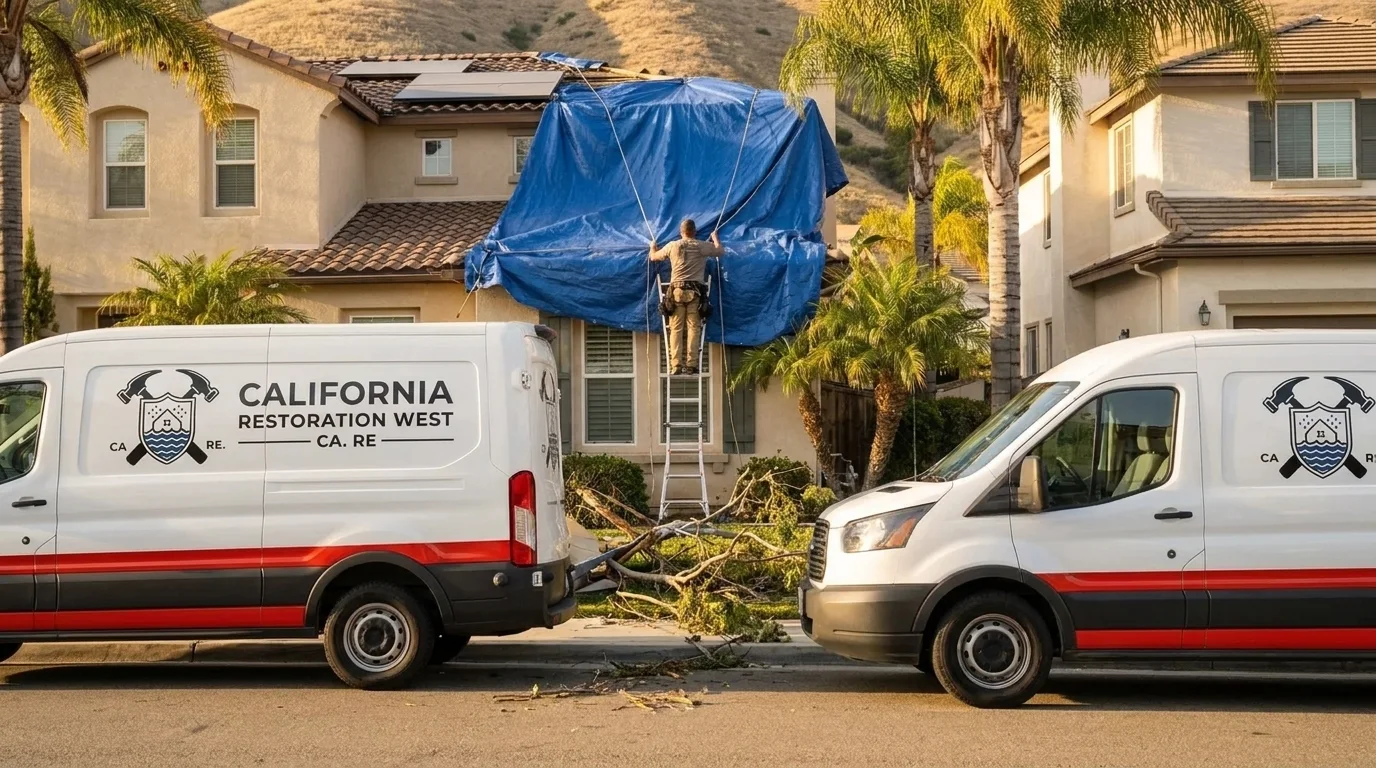
Emergency stabilization and weather barrier, Before any drying or debris work begins, the structure needs to stop taking on new water. That means roof tarping, board-up of broken windows and doors, and temporary weatherproofing of any breached exterior. This step protects both the property and the drying work that follows.
-
Damage documentation and moisture mapping, Every affected surface is photographed and logged. Thermal imaging identifies moisture migration behind walls and ceilings that looks dry to the eye. This documentation becomes the foundation of the insurance claim and the drying log, without it, adjusters have no basis to approve hidden-damage line items.
-
Debris removal and tree damage cleanup, Fallen limbs and debris are cleared with attention to what’s underneath: impact damage to roofing, siding, or foundation areas that may not be obvious until the debris is gone. Larger tree removals are coordinated with licensed arborists when root systems or structural contact require it.
-
Water extraction and structural drying, Standing water is extracted, then drying equipment is placed based on the moisture map, not just in the rooms that look wet. Readings are logged daily. Equipment is repositioned or added as the drying picture changes. The goal is verified dry, not assumed dry.
-
Repair scope and reconstruction, Once the structure is dry and stable, a written repair scope covers everything from roofing and siding to interior finishes. Work is sequenced so that inspections and any required permits are pulled before finish work begins.
What separates a good storm damage response from a bad one
The most common failure in severe weather damage repair is treating visible damage as the complete picture. A contractor who patches the roof and calls it done, without checking whether wind-driven rain penetrated the wall assembly, is leaving a mold problem behind the drywall. Insurance adjusters increasingly look for moisture logs and thermal images as proof that hidden damage was identified and addressed; without them, supplement claims for secondary damage are difficult to support.
A second common gap is sequencing. Reconstruction started before structural drying is complete traps moisture inside new finishes. Drywall hung over wet framing will fail, and the resulting mold remediation costs more than the drying would have.
On the documentation side, storm losses often involve multiple damage types that cross policy coverage categories. A thorough operator separates wind damage, water intrusion, and impact damage in the scope of work because adjusters review them differently. Bundled line items get denied or underpaid.
What does Storm Damage Restoration cost?
Typical costs for storm damage restoration vary widely depending on the size of the structure, how many damage types are involved, and how quickly the response begins. Most homeowners pay somewhere in the ranges below for common storm loss scenarios, these are industry-typical figures, not quotes.
| Scenario | Typical range |
|---|---|
| Minor roof damage, no interior water intrusion | $800 – $3,000 |
| Wind-driven rain, single room affected | $2,500 – $6,000 |
| Tree impact, partial roof breach, interior water | $8,000 – $25,000 |
| Widespread roof damage with structural drying | $15,000 – $45,000 |
| Full storm loss with reconstruction | $40,000 – $120,000+ |
Every loss is different, and California Restoration West provides a written scope of work before any work begins so there are no surprises. Homeowners insurance typically covers sudden storm-related damage, wind, hail, falling trees, and resulting water intrusion, though flood damage from ground-level water generally requires a separate flood policy. Reviewing your declarations page before a storm season is the best way to know where your coverage starts and stops.
Seasonal and regional considerations
Ventura County’s storm season runs roughly November through March, with atmospheric river events capable of delivering several inches of rain in 24 hours, more than the region’s aging drainage infrastructure is designed to handle quickly. Hillside neighborhoods in areas like Ojai and Ventura’s east end face additional exposure from debris flows and soil saturation following dry-season fire activity, which strips vegetation and destabilizes slopes. Coastal properties deal with wind-driven salt spray that accelerates corrosion on exposed fasteners and flashing after a storm breach. These regional patterns mean that what looks like a straightforward roof leak can carry complications that don’t show up until drying is underway.
Service area
California Restoration West is based in Ventura and responds to storm damage throughout Ventura County, including Oxnard, Camarillo, Thousand Oaks, Simi Valley, Santa Paula, Fillmore, Ojai, and Port Hueneme. Individual city service pages link back here for the full process detail.
If your property took storm damage, a compromised roof, a downed tree, water inside the walls, call (805) 290-7292 to get a crew moving and a written scope started before secondary damage sets in.
Services We Handle
- Emergency Board Up
- Emergency Storm Damage Repair
- Emergency Tarping
- Hurricane Damage Restoration
- Storm & Wind Damage Restoration
- Wind Damage Repair
Frequently Asked Questions
Does homeowners insurance cover storm damage restoration?
A tree fell on my roof last night. What should I do before the restoration crew arrives?
How do you find water damage inside walls after a storm if the surface looks dry?
How long does storm-related structural drying typically take?
What documentation does an insurance adjuster typically need for a storm damage claim?
Looking for the best storm damage restoration company in Ventura?
California Restoration West provides storm damage restoration in Ventura, CA and the surrounding area, and has served local property owners since 2025. Customers rate us 5.0 out of 5 stars across 9 Google reviews. We answer calls 24/7 — call (805) 290-7292 for immediate help.
Need Storm Damage Restoration now?
We respond 24/7 across Ventura and surrounding CA cities.
Related Coverage
- Our Restoration Services
- Contents Restoration and Storage in Ventura
- Crawl Space Encapsulation in Ventura
- Mold Remediation in Ventura
- 24/7 Emergency Water Removal & Cleanup in Ventura
- 24/7 Emergency Water Damage Restoration in Ventura
- Contact California Restoration West
- 24/7 Emergency Storm Damage Restoration in Camarillo
- 24/7 Emergency Storm Damage Restoration in Fillmore
- 24/7 Emergency Storm Damage Restoration in Ojai
- 24/7 Emergency Storm Damage Restoration in Oxnard
- 24/7 Emergency Storm Damage Restoration in Port Hueneme
- 24/7 Emergency Storm Damage Restoration in Santa Paula
- 24/7 Emergency Storm Damage Restoration in Simi Valley
- 24/7 Emergency Storm Damage Restoration in Thousand Oaks
- Storm Damage Insurance Claim Checklist (Use This Before You Call Your Insurer)