24/7 Emergency Storm Damage Restoration in Fillmore
24/7 emergency storm damage restoration in Fillmore, CA. IICRC-certified, insurance billing accepted. Call (805) 290-7292.
Our IICRC-certified technicians are dispatched from our Ventura, CA headquarters and are typically on-site in Fillmore within 60 minutes of your call.
Fillmore sits in the Santa Clara River Valley, where the Santa Monica Mountains and Topatopa range funnel winter storms off the Pacific into a narrow corridor, and when those systems stall, the combination of saturated hillside soils, debris-laden runoff, and sustained wind gusts can turn a moderate rain event into serious structural damage almost overnight. California Restoration West responds to storm damage calls in Fillmore around the clock, bringing IICRC-certified crews and industrial drying equipment to a community where the landscape itself amplifies what the weather delivers.
Why Fillmore Properties See Storm Damage Differently Than Coastal Cities
Fillmore’s position roughly 35 miles inland from the Ventura coast means it misses the marine layer that moderates temperatures on the shoreline, but it catches the channeled energy of storms that accelerate through mountain passes. During Santa Ana wind events, gusts that seem manageable in Ventura can arrive in Fillmore with enough force to strip roofing, drop mature citrus and oak trees onto structures, and drive rain horizontally under eaves and through window seals that were never designed for that angle of entry.
The valley floor’s clay-heavy soils, common throughout this part of Ventura County, absorb moisture slowly and drain even more slowly. After a heavy storm, water that has nowhere to go pools against foundation walls, finds its way through crawlspace vents, and wicks into wood framing before a homeowner realizes the exterior has been breached. Homes built in Fillmore’s older residential core, many of them constructed in the mid-20th century with wood-framed walls and original stucco exteriors, are particularly vulnerable to this kind of slow infiltration because the stucco can mask moisture intrusion for days.
Our Storm Damage Restoration Process in Fillmore
Every storm loss is different, but the sequence that protects a Fillmore home follows a consistent logic: stop additional intrusion, document everything, dry what can be dried, and replace what cannot.
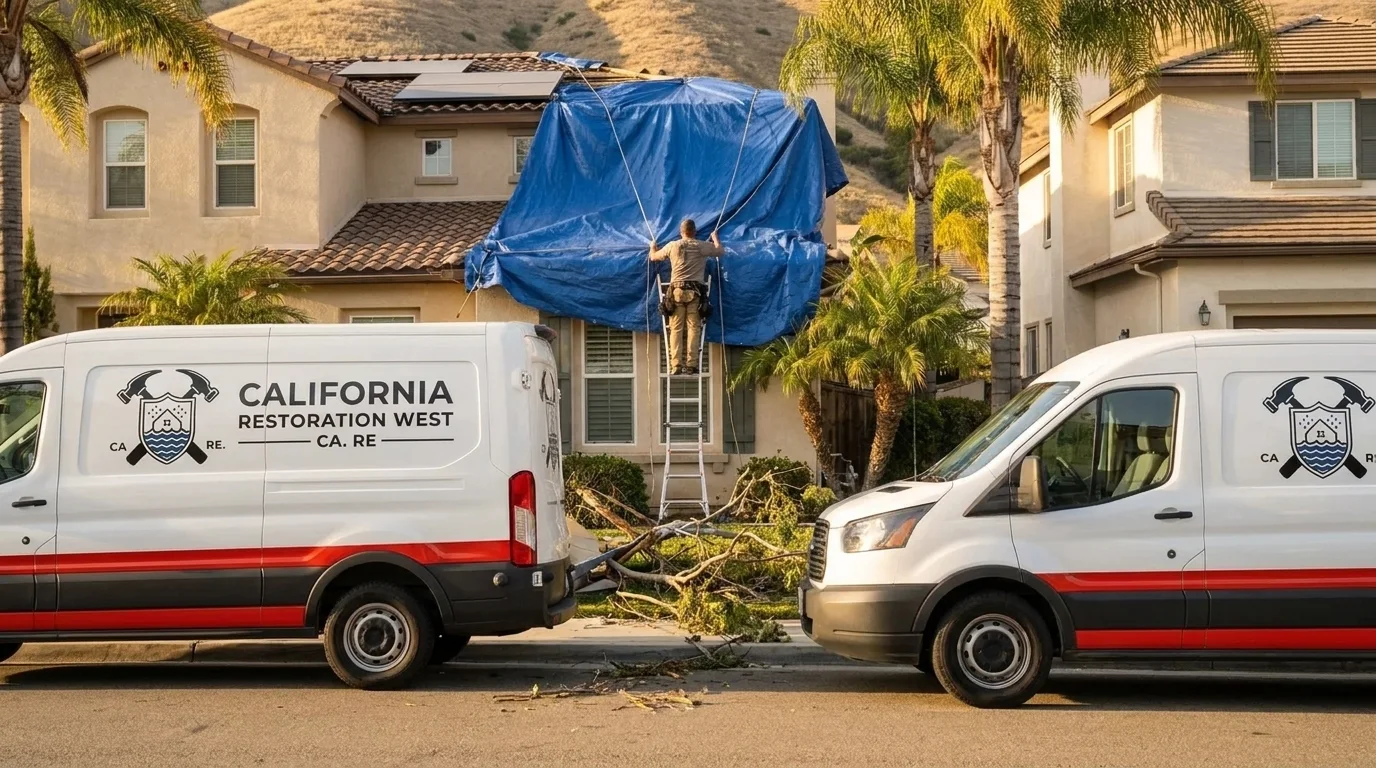
Emergency stabilization comes first. If a tree has breached a roof or a window has failed, we tarp and board before any drying equipment goes in, moisture control is pointless if the sky still has access to the interior.
Moisture mapping follows immediately. We use thermal imaging and calibrated moisture meters to trace water movement through walls, subfloors, and ceiling assemblies. In Fillmore’s older stucco homes, water often migrates laterally through the wall cavity well beyond the visible damage point, so we map a wider perimeter than the obvious wet zone.
Structural drying uses commercial-grade desiccant and refrigerant dehumidifiers alongside high-velocity air movers positioned to create directed airflow through affected cavities. Our IICRC ASD-certified technicians set drying goals based on the IICRC S500 standard and monitor readings daily until materials reach acceptable equilibrium moisture content.
Documentation for insurance runs parallel to every step. We photograph affected materials, log moisture readings with timestamps, and produce a scope of damage that gives your adjuster the data they need to process the claim.
Reaching Fillmore from Our Ventura Base
California Restoration West is based in Ventura, and Highway 126 is the direct route east into Fillmore, a corridor our crews travel regularly. Because we operate 24/7, a call placed at any hour gets a live response, not a voicemail queue. Storm events that affect Fillmore often affect the broader Santa Clara River Valley simultaneously, so we stage equipment and personnel in advance when a significant weather system is forecast for Ventura County.
Fillmore Insurance Coordination
Most homeowner policies cover sudden and accidental storm damage, wind-driven rain intrusion, falling trees, hail impact, but the documentation burden falls on the property owner to initiate. We work directly with insurance carriers, providing the moisture logs, photo documentation, and written scope that adjusters require. We can also communicate directly with your assigned adjuster to answer technical questions about drying methodology or material replacement decisions, which often shortens the approval timeline. If your carrier requires a third-party estimate before authorizing work, we can help you understand that process and what to request.
Local Note
Fillmore’s agricultural heritage means many residential parcels on the edges of town sit near mature windbreak trees, eucalyptus and pepper trees planted decades ago to protect citrus groves. These trees are large, their root systems are often compromised by years of irrigation cycling, and they fall on structures at a rate that surprises homeowners who assume they are stable. After a significant storm, it is worth walking the perimeter of any outbuilding or fence line near mature trees before assuming the only damage is to the main structure. Secondary impacts from partially downed limbs that shift hours after the storm are a pattern we see in this part of the valley.
If storm damage has hit your Fillmore property, whether it is a breached roof, a flooded crawlspace, or a tree through a wall, call California Restoration West at (805) 290-7292. We are available around the clock, and we will send a certified crew to assess the damage, stop further intrusion, and walk you through every step from emergency stabilization to final repair.
Serving Fillmore from our Ventura headquarters — ★ 5.0 · 9 Google reviews
“Jimmy is Very Professional and knowledgeable. One of the best in the industry.” — Jeffrey, November 2025Read our reviews on Google →
Storm Damage Restoration in Fillmore: Service Coverage
Frequently Asked Questions
How fast can you arrive for storm damage restoration in Fillmore?
How quickly can California Restoration West reach Fillmore after a storm emergency?
Fillmore gets intense wind events through the mountain passes — does wind-driven rain intrusion qualify as a covered storm loss?
Fillmore has a lot of older stucco homes — does that affect how storm water damage is dried?
A tree fell on my Fillmore property during a storm and damaged the roof and an interior room — where do you start?
Does the clay soil common in the Fillmore area affect crawlspace flooding after heavy rain?
Will my homeowners insurance cover storm damage restoration in Fillmore?
Storm Damage Restoration response in Fillmore
Most Fillmore calls see a technician on-site within 60 minutes from our Ventura headquarters.