24/7 Emergency Water Damage Restoration in Ventura
24/7 emergency water damage restoration in Ventura and surrounding areas. IICRC-certified, insurance billing accepted. Call (805) 290-7292.
Water damage emergency in Ventura? We answer 24/7. Call now and our crew heads out to stop the water and start drying your property.
Water you can see is only part of the problem. Within the first hour after a pipe bursts or a washing machine line fails, water is already moving, wicking into drywall, traveling under flooring, pooling inside wall cavities where no one will notice it until the smell starts or the paint bubbles. The clock matters here because wet building materials don’t stay wet in isolation: at the right temperature and humidity, mold colonization can begin in as little as 24 to 48 hours. Water damage restoration is the work of stopping that clock.
What water damage restoration actually involves
Water damage restoration is not mopping up and running a fan. The work is a sequence of decisions driven by moisture readings, material types, and water category, and each decision affects how long drying takes, what gets saved versus removed, and what your insurance carrier will approve.
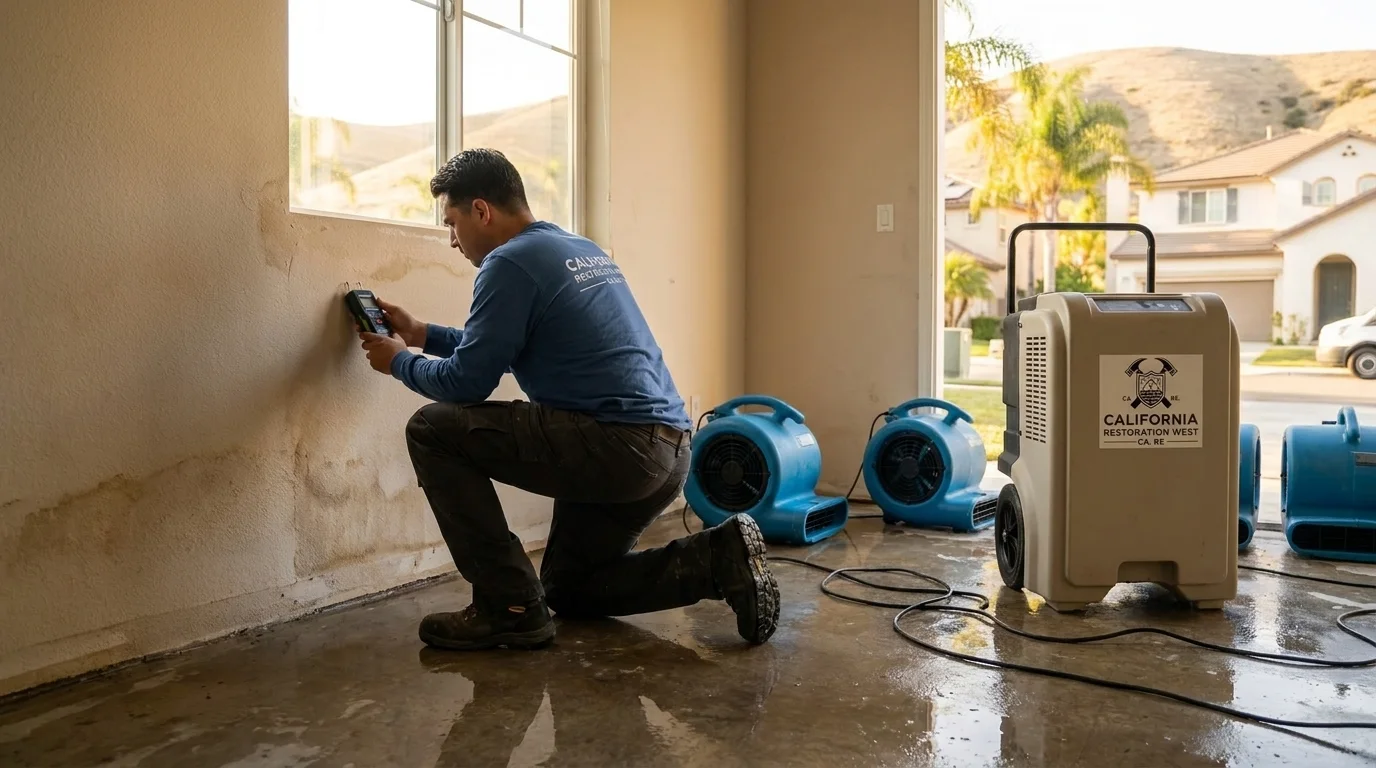
The first tool on site is a moisture meter, not a mop. Technicians probe walls, subfloor assemblies, and ceiling materials to map the full extent of saturation, which is almost always larger than the visible wet area. From there, the right extraction and drying equipment gets staged: truck-mounted or portable extractors pull standing water and surface moisture; commercial-grade desiccant or refrigerant dehumidifiers lower the vapor pressure in the air; axial and centrifugal air movers accelerate evaporation from structural surfaces. Thermal imaging cameras help locate moisture hidden inside assemblies without unnecessary demolition.
The water category matters at every step. Category 1 (clean water from a supply line) is the most straightforward to dry in place. Category 2 (gray water from an appliance overflow or toilet tank) requires more caution with porous materials. Category 3 (black water, sewage, rising groundwater, or floodwater) typically means affected porous materials come out rather than get dried, and containment protocols go up.
In Ventura’s coastal climate, ambient humidity can slow structural drying significantly compared to drier inland areas. That’s not an excuse for a longer job, it’s a reason to stage more dehumidification capacity from the start.
Our process
-
Emergency response and safety assessment. We arrive, identify any active water source, and confirm it’s been shut off. We assess electrical hazards, document the loss with photos and moisture readings, and communicate the scope to you before work begins.
-
Water extraction. Standing water and surface moisture are removed using high-capacity extractors. For carpet and pad, weighted extraction tools pull water that a standard vacuum wand won’t reach. Speed here directly reduces total drying time.
-
Controlled demolition and material triage. Saturated drywall, insulation, and flooring that cannot be effectively dried in place are removed, not because it’s easier, but because leaving wet porous material behind is how mold problems start. We document everything removed for your insurance claim.
-
Structural drying with daily monitoring. Drying equipment is positioned based on the moisture map, not guesswork. We return daily to log temperature, relative humidity, and material moisture content using calibrated meters. Drying is not complete until readings reach established dry standards, we follow IICRC S500 guidelines for structural drying.
-
Final documentation and clearance. When all affected materials reach target moisture levels, we produce a drying log with daily readings from start to finish. This documentation is what your insurance adjuster needs to close the claim and what protects you if a secondary issue surfaces later.
What separates a good water damage response from a bad one
The most common failure in water damage restoration is stopping too soon. A surface that reads dry with a pin meter can still carry significant moisture deeper in the assembly, particularly in Ventura’s older housing stock, where plaster over lath, hardwood subfloors, and multi-layer flooring systems hold water in ways that modern materials don’t. A technician who logs one reading per room and pulls equipment on day three is not doing the same job as one who maps multiple points per assembly and holds equipment until every reading hits target.
A second common failure is ignoring the water category. Gray or black water that gets treated like clean water, dried in place rather than removed, leaves contaminants behind in the structure. Insurance adjusters trained in water damage claims know what to look for, and a claim that shows Category 2 water dried in place without appropriate material removal will generate questions.
Good operators also document obsessively. Daily moisture logs, pre- and post-photos, equipment placement records, and a written scope before work begins are not paperwork for paperwork’s sake, they are the record that protects the homeowner if the claim is disputed or a secondary loss appears months later. Our IICRC certifications in Water Restoration Technology (WRT) and Applied Structural Drying (ASD) reflect the technical standards behind that documentation.
What does water damage restoration cost?
Typical costs vary significantly based on how much water entered the structure, where it went, and what category it falls into. Most homeowners pay somewhere in the ranges below, these are industry-typical figures, not quotes.
| Scenario | Typical range |
|---|---|
| Single room, clean water (Category 1), no demolition | $1,200 – $3,500 |
| Single room, clean water, drywall and flooring removal | $3,000 – $6,500 |
| Multi-room or whole-floor event, Category 1–2 | $5,000 – $15,000 |
| Finished basement, Category 2 water | $7,000 – $20,000 |
| Category 3 (sewage or floodwater), any size | $10,000 – $30,000+ |
| Crawl space saturation | $3,500 – $12,000 |
Every loss is different, square footage, construction type, how long the water sat, and what materials were affected all shift the number. California Restoration West provides a written scope before work begins so you know what you’re approving. Standard homeowners insurance typically covers sudden and accidental water damage (a burst pipe, an appliance failure) but excludes gradual leaks and flood events, flood damage requires a separate NFIP or private flood policy.
Seasonal and regional considerations
Ventura County’s rainy season runs roughly November through March, and the region’s combination of aging infrastructure, hillside drainage patterns, and clay-heavy soils creates predictable stress points each year. Roof penetrations that hold up through a dry summer can fail under the first sustained rain. Flatwork and hardscape that drains toward the foundation, common on lots graded before modern drainage codes, can push water against stem walls and into crawl spaces. After a dry stretch followed by heavy rain, the ground’s reduced absorption capacity means surface water moves fast and finds the lowest entry point into a structure.
Coastal humidity also means that water damage left unaddressed, even from a relatively small event, sits in an environment that favors mold growth. The window between a wet event and the start of remediation is shorter here than in drier climates.
Service area
California Restoration West is based in Ventura and serves communities throughout Ventura County and the surrounding region, including Oxnard, Camarillo, Thousand Oaks, Simi Valley, Santa Paula, Fillmore, Moorpark, and Ojai. The city-specific pages linked from this site go deeper on local considerations, housing stock, drainage patterns, and typical loss types, for each area.
If you’re seeing water where it shouldn’t be, call (805) 290-7292 to schedule your moisture assessment. We’re available 24/7, and the first step, understanding exactly where the water went, costs you nothing to find out.
Services We Handle
- Carpet Water Damage
- Carpet Water Extraction
- Ceiling Water Damage Repair
- Flood Restoration
- Hardwood Floor Water Damage
- Laminate Floor Water Damage
- Roof Leak Water Damage
- Water Damage Cleanup Repair
- Water Damage Repair
- Water Damage Under Flooring
- Water Leak Detection
- Water Mitigation
- Wet Drywall Repair
- Wood Floor Water Damage Repair
Frequently Asked Questions
Does homeowners insurance cover water damage restoration?
How long does structural drying take, and what affects the timeline?
What's the difference between Category 1, 2, and 3 water, and why does it change what gets removed?
What should I do — and not do — while waiting for the crew to arrive?
How do technicians find water that's hidden inside walls or under flooring?
Looking for the best water damage restoration company in Ventura?
California Restoration West provides water damage restoration in Ventura, CA and the surrounding area, and has served local property owners since 2025. Customers rate us 5.0 out of 5 stars across 9 Google reviews. We answer calls 24/7 — call (805) 290-7292 for immediate help.
Need Water Damage Restoration now?
We respond 24/7 across Ventura and surrounding CA cities.
Related Coverage
- Our Restoration Services
- Contents Restoration and Storage in Ventura
- Crawl Space Encapsulation in Ventura
- Mold Remediation in Ventura
- 24/7 Emergency Storm Damage Restoration in Ventura
- 24/7 Emergency Water Removal & Cleanup in Ventura
- Contact California Restoration West
- 24/7 Emergency Water Damage Restoration in Camarillo
- 24/7 Emergency Water Damage Restoration in Fillmore
- 24/7 Emergency Water Damage Restoration in Ojai
- 24/7 Emergency Water Damage Restoration in Oxnard
- 24/7 Emergency Water Damage Restoration in Port Hueneme
- 24/7 Emergency Water Damage Restoration in Santa Paula
- 24/7 Emergency Water Damage Restoration in Simi Valley
- 24/7 Emergency Water Damage Restoration in Thousand Oaks
- Burst Pipe Emergency Checklist: Step-by-Step Response
- What To Do in the First 24 Hours After Water Damage
- How To Choose a Restoration Company in Ventura (Without Getting Burned)
- 24/7 Emergency Water Damage Restoration in Casa Conejo
- 24/7 Emergency Water Damage Restoration in Channel Islands Beach
- 24/7 Emergency Water Damage Restoration in El Rio
- 24/7 Emergency Water Damage Restoration in Meiners Oaks
- 24/7 Emergency Water Damage Restoration in Saticoy