
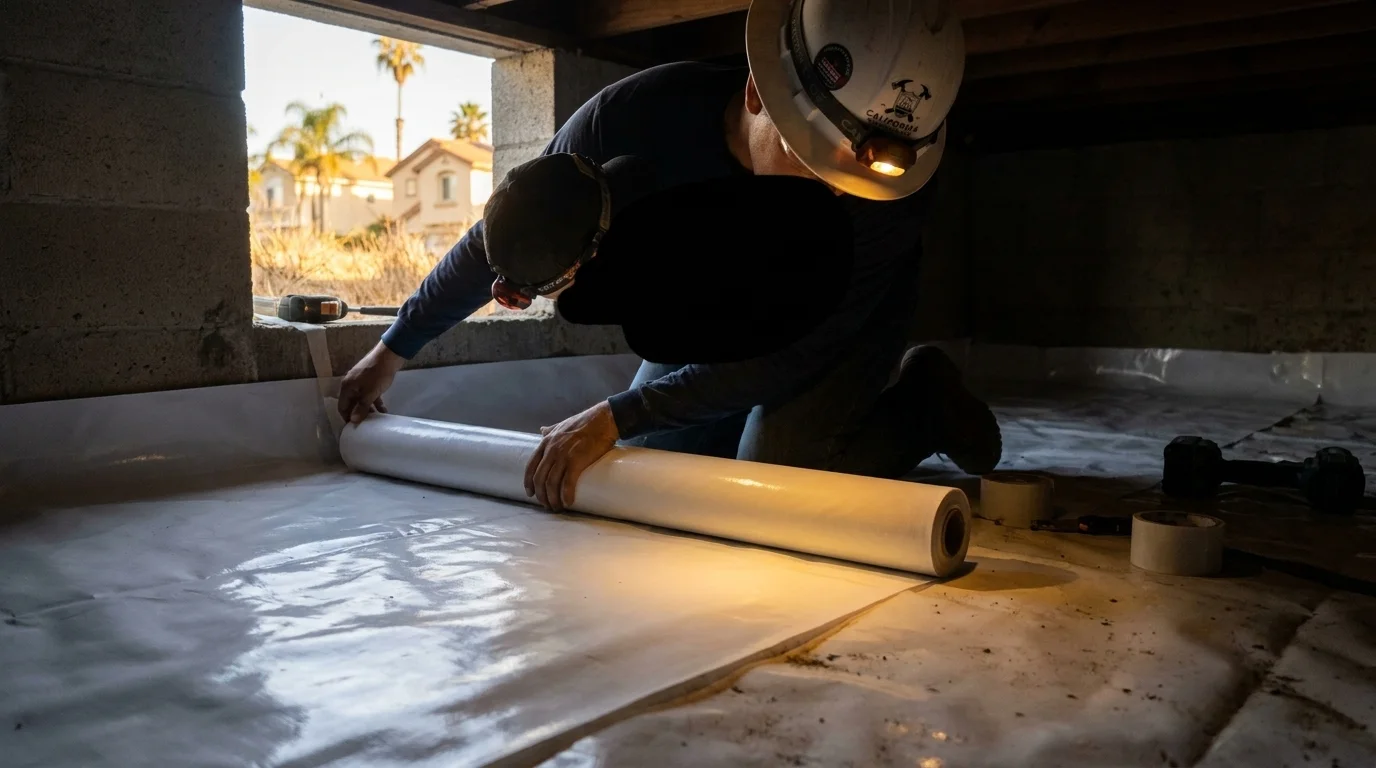
Crawl Space Encapsulation in Ventura
24/7 crawl space encapsulation in Ventura and surrounding areas. IICRC-certified, insurance billing accepted. Call (805) 290-7292.
If your floors feel soft in winter, your energy bills spike without explanation, or you catch a faint musty smell that no amount of cleaning fixes, the source is often underneath the house. Crawl spaces in coastal Southern California trap ground moisture year-round: marine layer humidity seeps in through open vents, condensation forms on cold joists, and bare soil off-gases water vapor directly into the framing above. Encapsulation seals that moisture pathway at the source, before it rots wood, feeds mold colonies, or drives up your HVAC load.
What crawl space encapsulation actually involves
Encapsulation is not simply rolling out a sheet of plastic. The work begins at the ground and works upward: the soil is covered with a thick, reinforced vapor barrier (typically 12–20 mil polyethylene or reinforced laminate) that is sealed at every seam and mechanically fastened to the foundation walls. Exposed concrete piers, posts, and footings are wrapped and sealed as part of the same system. Existing fiberglass batt insulation, which absorbs moisture and loses R-value when wet, is often removed and replaced with closed-cell spray foam or rigid foam board applied to the crawl space walls instead of the floor above.
Ventilation strategy is reconsidered at the same time. Traditional vented crawl spaces made sense in older building science thinking, but in Ventura’s climate, where outdoor humidity regularly exceeds 70 percent during marine layer months, venting the crawl space can introduce more moisture than it removes. Many encapsulation projects include closing or conditioning the space and adding a dedicated crawl space dehumidifier with a drain line, keeping relative humidity consistently below 55 percent where mold cannot colonize.
The timeline for a standard single-family crawl space runs one to two days for the encapsulation itself, with an additional day if significant debris removal, mold treatment, or insulation replacement is needed.
Our process
-
Inspection and moisture mapping. Before any material goes in, the crawl space is inspected for standing water, active leaks, existing mold growth, wood rot, pest damage, and current insulation condition. Moisture readings are taken at the subfloor, joists, and soil surface. This baseline determines whether remediation work must precede encapsulation.
-
Debris removal and surface prep. Old insulation, construction debris, and any organic material sitting on the soil are removed. If mold is present on joists or the subfloor, it is addressed per IICRC AMRT protocols, encapsulation over active mold growth traps the problem rather than solving it.
-
Liner installation and seaming. The vapor barrier is cut, overlapped at seams by a minimum of 12 inches, and sealed with manufacturer-specified tape rated for long-term adhesion. Edges are run up the foundation wall and fastened with termination bar or mechanical fasteners, not just tucked under gravel, which allows the liner to shift and gap over time.
-
Penetration sealing and wall insulation. Every pipe, wire, and column penetrating the liner is sealed with compatible mastic or foam. Foundation walls are insulated to reduce thermal bridging and condensation on cold concrete surfaces.
-
Humidity control and final documentation. A calibrated dehumidifier is sized to the cubic footage of the space and set to maintain target relative humidity. Post-installation moisture readings are documented and provided to the homeowner, useful for insurance records and future inspections.
What separates a good encapsulation from a bad one
The most common failure point is skipping the moisture investigation before installation. A liner installed over saturated soil or active wood rot creates an anaerobic environment that accelerates decay rather than stopping it. Experienced operators take moisture readings at multiple depths and locations, not just a single spot near the access hatch.
Seam integrity is the second place projects fail. Cheap tape delaminates within a season. Seams that are simply overlapped without mechanical fastening shift when anyone enters the crawl space for future plumbing or HVAC work. A properly installed liner should be serviceable for 20-plus years without reseaming.
Insurance adjusters reviewing encapsulation claims tied to water damage or mold losses look specifically for documentation that the source of moisture was identified and corrected before encapsulation, not just covered over. They also look for photo documentation of conditions before work began, which is why a thorough pre-job inspection with timestamped images matters.
Finally, ventilation strategy must match the building. Closing a crawl space without a conditioning or dehumidification plan in a humid coastal climate can create a sealed, humid box, worse than the original vented configuration.
What does crawl space encapsulation cost?
Typical costs run across a wide range depending on crawl space size, access difficulty, existing conditions, and the scope of work required before the liner goes in. Most homeowners pay somewhere in the ranges below, these are industry-typical figures, not a quote from California Restoration West.
| Scenario | Typical range |
|---|---|
| Small crawl space, clean conditions, liner only | $1,500 – $3,500 |
| Average crawl space with old insulation removal | $3,500 – $6,500 |
| Crawl space with mold treatment required first | $5,000 – $10,000 |
| Full encapsulation with dehumidifier and wall insulation | $6,000 – $12,000 |
| Large or difficult-access crawl space, full scope | $10,000 – $18,000+ |
Every loss and every crawl space is different, California Restoration West provides a written scope of work before any work begins so there are no surprises. Homeowners insurance typically does not cover elective encapsulation, but when encapsulation is recommended as part of a covered water damage or mold remediation claim, the portion tied to that loss may be billable to your carrier.
Seasonal and regional considerations
Ventura sits in a climate zone where the marine layer keeps nighttime humidity high for much of the year, not just in a defined rainy season. Condensation on cold crawl space surfaces can occur on any cool morning after a warm day, a pattern that runs from late spring through early fall, not just during winter rains. Homes built on slab-on-grade are unaffected, but the older wood-frame housing stock throughout Ventura, Oxnard, and the foothill communities typically sits on raised foundations with vented crawl spaces that were designed for a drier inland climate model.
Santa Ana wind events drive low humidity for days at a time, which can mask moisture readings if an inspection happens to fall during one of those windows. Moisture mapping done after a marine layer period gives a more accurate picture of what the crawl space lives with most of the year.
Service area
California Restoration West is based in Ventura and serves crawl space encapsulation clients throughout Ventura County and the surrounding region, including Oxnard, Camarillo, Thousand Oaks, Moorpark, Simi Valley, Santa Paula, Fillmore, and Ojai. City-specific pages cover local permitting notes and housing stock details for each community.
If the air inside your home smells older than the house should, or your floors have developed a seasonal softness you can’t explain, the crawl space is the place to start. Call (805) 290-7292 to schedule a crawl space moisture assessment, California Restoration West will document what’s down there, explain what it means, and give you a written scope before any work begins.
Frequently Asked Questions
Does homeowners insurance cover crawl space encapsulation?
Can you encapsulate a crawl space that already has mold on the joists?
Should crawl space vents be open or closed after encapsulation?
How thick should a crawl space vapor barrier be, and does it matter?
How do I know if my crawl space needs encapsulation or just a dehumidifier?
Looking for the best crawl space encapsulation company in Ventura?
California Restoration West provides crawl space encapsulation in Ventura, CA and the surrounding area, and has served local property owners since 2025. Customers rate us 5.0 out of 5 stars across 9 Google reviews. We answer calls 24/7 — call (805) 290-7292 for immediate help.
Need Crawl Space Encapsulation now?
We respond 24/7 across Ventura and surrounding CA cities.
Related Coverage
- Our Restoration Services
- Contents Restoration and Storage in Ventura
- Mold Remediation in Ventura
- 24/7 Emergency Storm Damage Restoration in Ventura
- 24/7 Emergency Water Removal & Cleanup in Ventura
- 24/7 Emergency Water Damage Restoration in Ventura
- Contact California Restoration West
- Crawl Space Encapsulation in Camarillo
- Crawl Space Encapsulation in Fillmore
- Crawl Space Encapsulation in Ojai
- Crawl Space Encapsulation in Oxnard
- Crawl Space Encapsulation in Port Hueneme
- Crawl Space Encapsulation in Santa Paula
- Crawl Space Encapsulation in Simi Valley
- Crawl Space Encapsulation in Thousand Oaks
- Crawl Space Encapsulation in Hasley Canyon
- Crawl Space Encapsulation in Lake Sherwood
- Crawl Space Encapsulation in Mira Monte
- Crawl Space Encapsulation in Moorpark
- Crawl Space Encapsulation in Oak Park
- Crawl Space Encapsulation in Oak View
- Crawl Space Encapsulation in Piru
- Crawl Space Encapsulation in San Buenaventura (Ventura)
- Crawl Space Encapsulation in Santa Rosa Valley
- Crawl Space Encapsulation in Somis