
Crawl Space Encapsulation in Thousand Oaks
24/7 crawl space encapsulation in Thousand Oaks, CA. IICRC-certified, insurance billing accepted. Call (805) 290-7292.
Our IICRC-certified technicians are dispatched from our Ventura, CA headquarters and are typically on-site in Thousand Oaks within 60 minutes of your call.
Thousand Oaks sits in a transitional climate zone where the Santa Ana winds bake the soil dry for months, then winter rains push moisture back into the ground faster than it can drain, and that cycle is felt most acutely in the crawl spaces beneath the city’s ranch-style and split-level homes. If you’ve noticed a musty smell coming through your floor vents, or felt floors that flex slightly underfoot, the problem is often not the floor itself but the uncontrolled humidity collecting in the space below it. Crawl space encapsulation addresses that problem at the source.
Why Thousand Oaks Properties Are Prone to Crawl Space Moisture
Ventura County’s interior valleys, including the Conejo Valley where Thousand Oaks sits, experience a pronounced wet-dry swing that coastal communities don’t. During dry stretches, clay-heavy soils contract and pull away from foundation footings, creating pathways for cold air and soil gases. When the rains arrive, often in concentrated bursts between November and March, that same soil saturates quickly and holds moisture against concrete stem walls and wood framing for weeks.
The housing stock adds another layer. A significant portion of Thousand Oaks was built during the 1960s and 1970s, when vented crawl spaces were standard practice and vapor barriers, if used at all, were thin 6-mil poly sheeting stapled loosely to the ground. Decades of thermal cycling cause that sheeting to crack and curl, leaving large sections of bare soil exposed. Wood girders and subfloor sheathing above those gaps absorb ambient moisture and become hospitable to mold and wood-destroying organisms over time.
Our Crawl Space Encapsulation Process in Thousand Oaks
Encapsulation is not simply laying new plastic on the ground. The process starts with a thorough inspection, measuring moisture content in the wood framing, checking for standing water or efflorescence on the stem walls, and identifying any existing mold growth that needs to be addressed before sealing the space.
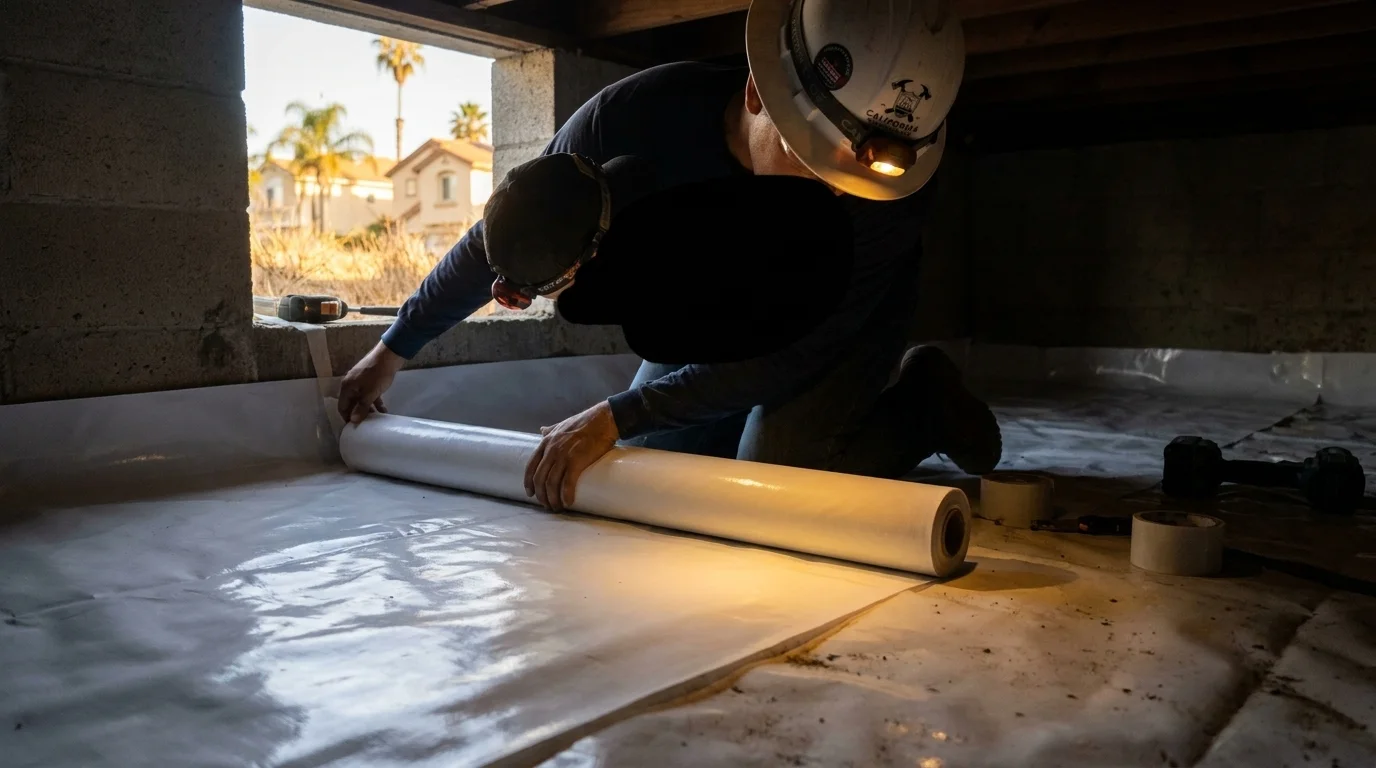
Once the crawl space is cleared and dried, we install a heavy-duty reinforced vapor barrier, typically 20-mil liner, that runs continuously across the ground and up the stem walls, sealed at every seam and penetration. Vents are evaluated: in many Thousand Oaks homes built to older code, open foundation vents actually introduce more humid outside air than they exhaust, and closing or conditioning those vents is often part of an effective encapsulation strategy. A dehumidifier sized to the square footage of the space is installed to maintain relative humidity at a level that discourages mold colonization and wood deterioration going forward.
All work is performed by an IICRC Certified Firm with technicians holding IICRC certifications in Water Damage Restoration, Mold Remediation, and Applied Structural Drying, so the team diagnosing your crawl space understands moisture science, not just installation.
Reaching Thousand Oaks from Ventura
California Restoration West is based in Ventura, and Thousand Oaks is a direct run east on the 101 Freeway, typically 25 to 35 minutes under normal traffic conditions. The team is available 24/7, so if you discover a moisture problem after a weekend rainstorm or notice a smell that’s been building for a while and finally want answers, a call to (805) 290-7292 reaches a live person any time.
Thousand Oaks HOA and Permit Considerations
Many planned developments in Thousand Oaks fall under HOA oversight, and some associations have specific requirements around exterior foundation work, access panels, and equipment installations. Before starting any encapsulation project, it’s worth confirming with your HOA whether a permit or written approval is required for modifications to the crawl space, particularly if the work involves closing foundation vents or adding mechanical equipment like a dehumidifier. The City of Thousand Oaks Building and Safety Division handles permits for this type of work, and requirements can vary based on the scope of the project. We can walk you through what documentation is typically needed so there are no surprises.
Local Note
Homes in the hillside areas of Thousand Oaks built on sloped lots often have crawl spaces that vary dramatically in height from one end to the other, sometimes only 18 inches at the high side and 4 or more feet at the low end. That geometry matters for encapsulation because moisture and cold air pool at the low end, and the liner installation has to account for the grade change to create a continuous seal. Crews unfamiliar with this configuration sometimes leave the low corner inadequately sealed, which is exactly where the problem concentrates. When we assess a property on a sloped lot, we take grade measurements across the full crawl space before specifying materials and liner quantities.
If you’re dealing with a musty crawl space, soft subfloor, or unexplained humidity inside your Thousand Oaks home, the underlying cause is often fixable, and encapsulation done correctly lasts for decades. Call California Restoration West at (805) 290-7292 to schedule an assessment and find out what’s actually happening beneath your floors.
Serving Thousand Oaks from our Ventura headquarters — ★ 5.0 · 9 Google reviews
“Jimmy and his team were great to work with — professional, responsive, and did excellent work here in the Thousand Oaks/Conejo Valley area. Highly recommend them for anyone looking for reliable, quality service.” — Davis, November 2025Read our reviews on Google →
Crawl Space Encapsulation in Thousand Oaks: Service Coverage
Frequently Asked Questions
How fast can you arrive for crawl space encapsulation in Thousand Oaks?
Are Thousand Oaks homes built in the 1960s and 1970s more likely to need crawl space encapsulation?
How does Thousand Oaks' wet-dry climate cycle affect what type of encapsulation system is recommended?
Does my Thousand Oaks HOA need to approve crawl space encapsulation before work begins?
What does the encapsulation liner installation actually involve, and how long does it take?
Can crawl space moisture problems in Thousand Oaks be covered by homeowners insurance?
Crawl Space Encapsulation response in Thousand Oaks
Most Thousand Oaks calls see a technician on-site within 60 minutes from our Ventura headquarters.