24/7 Emergency Water Damage Restoration in Fillmore
24/7 emergency water damage restoration in Fillmore, CA. IICRC-certified, insurance billing accepted. Call (805) 290-7292.
Our IICRC-certified technicians are dispatched from our Ventura, CA headquarters and are typically on-site in Fillmore within 60 minutes of your call.
Fillmore sits in the Santa Clara River valley, where the combination of aging agricultural-era infrastructure, adobe-heavy soil that drains slowly after heavy rain, and a housing stock that includes many mid-century and older wood-frame homes creates conditions where water damage can escalate faster than most homeowners expect. When a supply line fails or a roof seam gives way during a winter storm, water doesn’t just pool on the surface, it wicks into subfloor assemblies and wall cavities before the damage is visible. California Restoration West responds 24/7 from Ventura, bringing IICRC-certified crews and professional drying equipment directly to Fillmore properties.
Why Fillmore Properties See Water Damage Issues
Fillmore’s position in Ventura County’s inland valley means it catches storm runoff from the surrounding hills in ways that coastal cities don’t. The Santa Clara River corridor can see rapid water-table fluctuations after significant rainfall, and older homes built on slab foundations with minimal vapor barriers are vulnerable to moisture intrusion from below as well as above. Many homes in Fillmore were constructed in the 1950s through 1970s, when building practices included galvanized steel supply lines that are now well past their service life. Galvanized pipe corrodes from the inside out, so a line that looks intact at the wall can be paper-thin at a fitting, and when it goes, it goes fast. Irrigation systems tied to the area’s agricultural heritage also run through residential properties, and a failed valve or cracked lateral can push significant volume into a crawl space or garage slab before anyone notices.
Our Water Damage Restoration Process in Fillmore
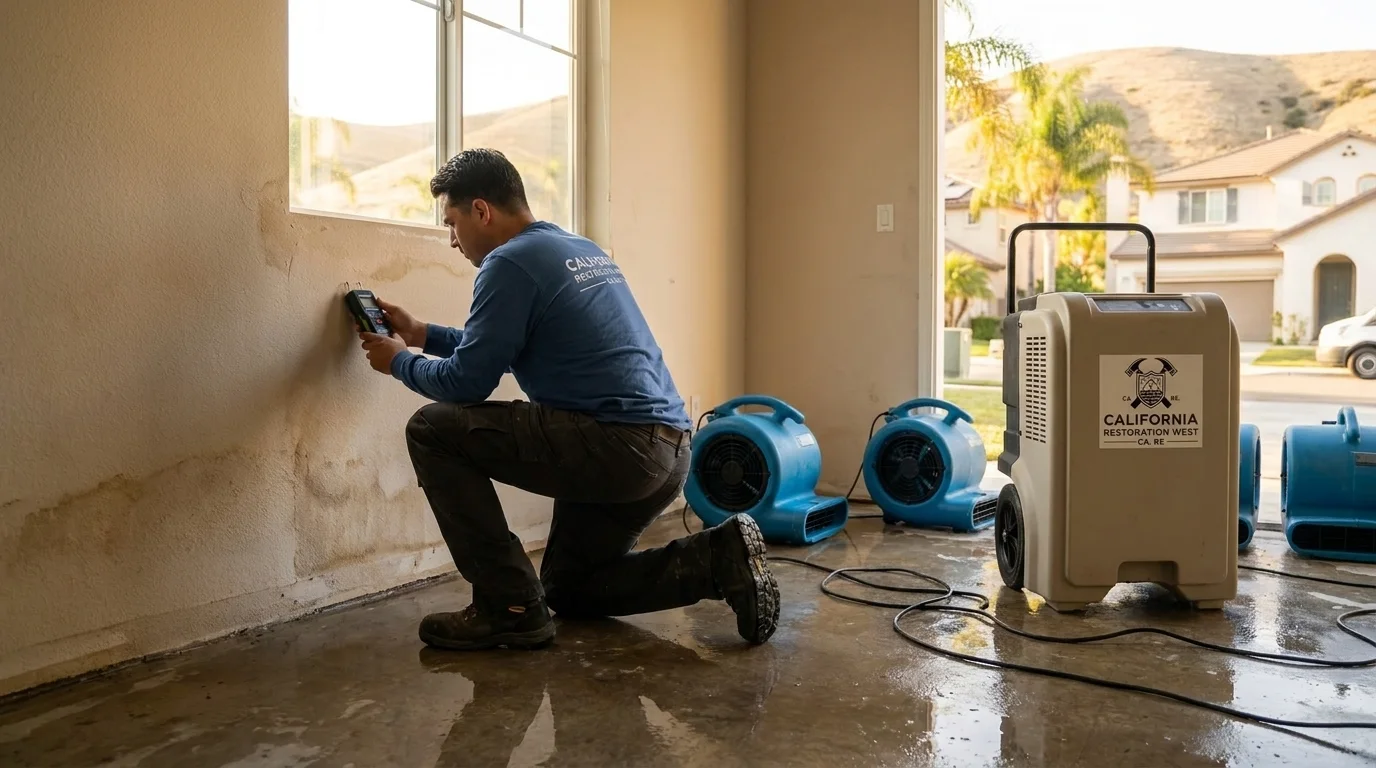
Every job starts with a moisture survey, not a visual inspection. Thermal imaging and calibrated moisture meters map where water has traveled behind drywall, under flooring, and into structural framing, because in older Fillmore homes with plaster-over-lath wall systems, the surface can read dry while the underlying wood stays saturated. Once the scope is documented, standing water is removed with truck-mounted extraction equipment. Structural drying follows using commercial-grade desiccant and refrigerant dehumidifiers paired with high-velocity air movers, positioned according to the IICRC S500 standard for psychrometric drying. Readings are logged daily so drying progress is documented, that data matters later if an insurance adjuster questions the scope or duration of the dry-out. Affected materials that cannot be dried in place, saturated insulation, buckled subfloor panels, compromised drywall, are removed and documented before reconstruction begins.
Reaching Fillmore from Ventura
From our Ventura base, the primary route to Fillmore runs east on Highway 126 through Piru, a corridor we travel regularly for calls throughout the Santa Clara River valley. Highway 126 is generally reliable, but winter storm events that bring the water damage calls in the first place can also slow the approach through the canyon stretches, we account for that and dispatch immediately on confirmation. Fillmore’s street grid is compact and most residential addresses are accessible without the staging complications you find in hillside communities, which means crews can set up extraction and drying equipment without significant delay once on site. Because we operate around the clock, a pipe failure at 2 a.m. gets the same response as one at noon.
Fillmore Insurance Coordination
Most standard homeowners policies in California cover sudden and accidental water discharge, a burst pipe, an appliance failure, an overflow, but exclude gradual leaks and flood events. The distinction matters in Fillmore, where slow-developing galvanized pipe failures can blur the line between sudden and gradual in an adjuster’s review. Thorough documentation from the first hour on site, photographs, moisture readings, scope notes, is what supports a clean claim. California Restoration West works directly with carriers, provides the required damage reports and drying logs, and can communicate with your adjuster throughout the process so you’re not managing that conversation alone while also dealing with a damaged home.
Local Note
Fillmore’s older wood-frame homes frequently have original hardwood floors laid over board subfloor rather than plywood, a construction detail common in homes built before the 1960s. Double-layer floor assemblies trap moisture between the boards, and the air gap between them can sustain elevated humidity long after the surface appears dry. Standard drying protocols designed for modern plywood subfloor systems underestimate drying time in these assemblies. We adjust equipment placement and extend monitoring cycles on these floors specifically, because pulling hardwood that could have been saved, because drying was called too early, is an outcome worth avoiding.
If water has reached the floors, walls, or structure of your Fillmore home, the window for limiting damage is short. Call California Restoration West at (805) 290-7292 any time, day or night, and a certified crew will be on the way.
Serving Fillmore from our Ventura headquarters — ★ 5.0 · 9 Google reviews
“Jimmy is Very Professional and knowledgeable. One of the best in the industry.” — Jeffrey, November 2025Read our reviews on Google →
Water Damage Restoration in Fillmore: Service Coverage
Frequently Asked Questions
How fast can you arrive for water damage restoration in Fillmore?
How quickly can California Restoration West reach Fillmore after I call?
Fillmore has a lot of older homes — does that affect how long the drying process takes?
My Fillmore home has galvanized pipes — is a slow leak covered differently by insurance than a sudden burst?
Can water from the Santa Clara River valley's seasonal rains get into a slab-foundation home in Fillmore?
What equipment do you use for structural drying, and how do you know when a Fillmore home is actually dry?
Water Damage Restoration response in Fillmore
Most Fillmore calls see a technician on-site within 60 minutes from our Ventura headquarters.