
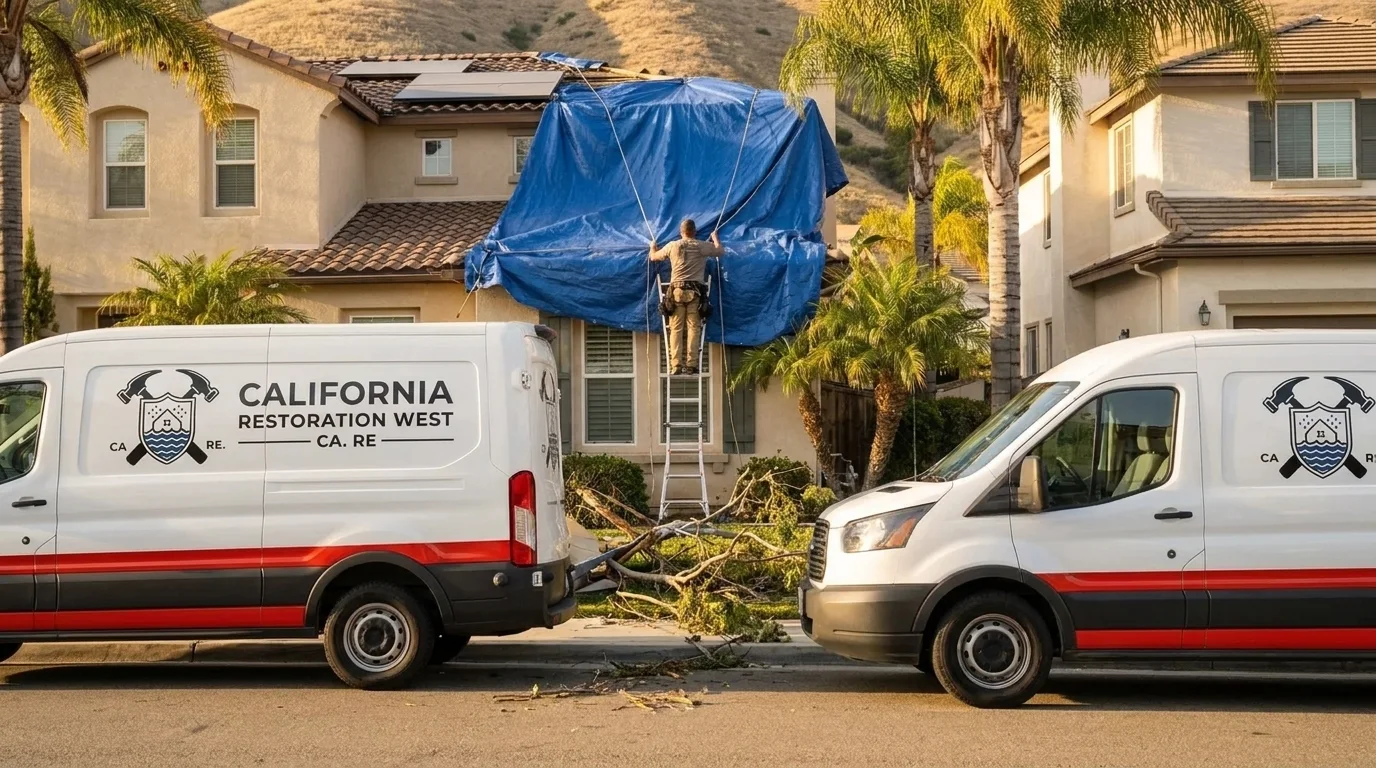
24/7 Emergency Storm Damage Restoration in Santa Paula
24/7 emergency storm damage restoration in Santa Paula, CA. IICRC-certified, insurance billing accepted. Call (805) 290-7292.
Our IICRC-certified technicians are dispatched from our Ventura, CA headquarters and are typically on-site in Santa Paula within 60 minutes of your call.
Santa Paula sits in a narrow river valley where the Santa Clara River corridor, the surrounding mountains, and the Santa Ana winds create a storm environment unlike most of Ventura County. When atmospheric rivers push through the Transverse Ranges and stall over the valley, rainfall intensity can spike fast, overwhelming drainage, saturating already-soft alluvial soils, and sending debris-laden runoff toward homes and commercial buildings that in many cases were built decades before current flood-resilience standards existed. California Restoration West responds 24/7 to storm damage calls throughout Santa Paula, working to stop secondary damage before it compounds the original loss.
Why Santa Paula Properties See Storm Damage Differently
The geography here does a lot of the work, and not in a good way. The valley floor channels water and wind in ways that surprise property owners who moved from flatter parts of Southern California. A moderate storm that barely registers in Ventura can translate into significant runoff, mudflow, and wind-driven debris in Santa Paula because the mountains to the north and east act as a funnel.
The housing stock adds another layer of complexity. A large portion of Santa Paula’s residential properties date from the mid-twentieth century or earlier, which means wood-frame construction with original stucco exteriors, single-pane windows, and roofing systems that may have been patched multiple times over the decades. When wind-driven rain finds a compromised roofline or a cracked stucco seam, it doesn’t stop at the surface, it tracks behind wall assemblies, soaks insulation, and reaches framing before a homeowner notices a stain on the ceiling. Older homes also tend to have shallow roof pitches common to California ranch-style construction, which hold standing water longer after a storm and accelerate shingle deterioration.
Soil saturation is a separate concern. The alluvial soils throughout the valley floor can shift after prolonged rain events, and properties near hillside slopes face the added risk of debris flow that can block drainage, damage foundations, and deposit sediment inside structures through crawl spaces or garage entries.
Our Storm Damage Restoration Process in Santa Paula
Every storm loss is different, but the sequence of decisions matters. When we arrive, the first priority is safety, identifying structural compromise, active electrical hazards, and gas line exposure before any equipment goes in. From there, the work follows a documented process calibrated to what storm damage actually looks like in this valley.
Damage assessment and documentation comes first. We photograph and measure affected areas systematically, which creates the record your insurance carrier needs to process the claim. This documentation covers not just the obvious, a collapsed section of fence, a caved-in soffit, but the less visible intrusion points where water entered and where it traveled.
Debris removal and tarping stabilizes the property against further loss. Fallen tree limbs, displaced roofing material, and broken glass get cleared. Exposed roof decking and wall openings get covered with commercial-grade tarps secured to prevent wind uplift.
Moisture mapping and structural drying follows. Our IICRC-certified team uses thermal imaging and calibrated moisture meters to trace water migration through wall cavities, subfloors, and ceiling assemblies. Drying equipment, industrial air movers, desiccant or refrigerant dehumidifiers depending on conditions, gets placed based on the readings, not guesswork.
Structural repair coordination closes the loop. Once materials are confirmed dry and the structure is stable, we coordinate or perform the repairs needed to bring the property back to pre-loss condition.
Reaching Santa Paula from Ventura
California Restoration West is based in Ventura. The primary route to Santa Paula is Highway 126 east through the valley, a direct corridor that keeps drive times manageable under normal conditions. Because we operate 24/7, we can dispatch at any hour, which matters when a storm rolls through overnight and a homeowner is dealing with a roof breach or a flooded garage before dawn. Storm events that affect Santa Paula often affect the Highway 126 corridor too, so our crews are familiar with alternate approaches when the main route is compromised by debris or flooding.
Santa Paula Insurance Coordination
Storm damage claims in California involve a few moving parts that are worth understanding before you call your carrier. Most homeowner policies cover sudden and accidental storm damage, wind, hail, falling trees, but the documentation burden falls on the policyholder to establish cause and scope. We work directly with insurance adjusters, providing the photo documentation, moisture readings, and written scope of work that carriers require. We also flag pre-existing conditions separately so that legitimate storm damage isn’t lumped in with deferred maintenance in a way that reduces your payout.
If your property falls under an HOA, check your CC&Rs before authorizing exterior repairs, some Santa Paula HOA communities have approval requirements for roofing materials or exterior finishes that can affect the repair scope. We can help identify those requirements early so repairs don’t have to be redone.
Local Note
Santa Paula’s older stucco homes present a drying challenge that isn’t obvious from the outside. Traditional three-coat stucco over wood lath holds moisture at the lath layer long after the surface reads dry on a pin-type meter. In storm events where wind-driven rain has been pushing against an exterior wall for hours, it’s common to find the inner face of the stucco and the lath behind it holding significant moisture even when the interior drywall feels fine to the touch. We use non-invasive thermal imaging alongside resistance readings at multiple wall depths to catch this before it becomes a mold problem weeks later, because in a valley that can stay humid after a storm system passes, wet lath doesn’t dry on its own.
If your home or business in Santa Paula has been hit by this season’s storms, call California Restoration West at (805) 290-7292. We’re available around the clock, and we’ll tell you honestly what we find, not what makes the scope sound bigger.
Serving Santa Paula from our Ventura headquarters — ★ 5.0 · 9 Google reviews
“Jim was professional, courteous and respectful of my spaces.” — Karen, October 2026Read our reviews on Google →
Storm Damage Restoration in Santa Paula: Service Coverage
Frequently Asked Questions
How fast can you arrive for storm damage restoration in Santa Paula?
How quickly can California Restoration West reach Santa Paula after a storm emergency?
Santa Paula has a lot of older homes — does that change how storm damage restoration works?
Does the Santa Clara River valley's flooding history affect storm damage claims in Santa Paula?
What's the risk of mold after a storm in Santa Paula's climate?
Can you handle tree damage cleanup as part of storm restoration in Santa Paula?
Will my homeowners insurance cover storm damage restoration in Santa Paula?
Storm Damage Restoration response in Santa Paula
Most Santa Paula calls see a technician on-site within 60 minutes from our Ventura headquarters.
Nearby & Related
- 24/7 Emergency Storm Damage Restoration in Ventura
- Restoration Services in Santa Paula
- Mold Remediation in Santa Paula
- 24/7 Emergency Water Damage Restoration in Santa Paula
- 24/7 Emergency Storm Damage Restoration in Camarillo
- 24/7 Emergency Storm Damage Restoration in Fillmore
- Contact California Restoration West