
24/7 Emergency Storm Damage Restoration in Thousand Oaks
24/7 emergency storm damage restoration in Thousand Oaks, CA. IICRC-certified, insurance billing accepted. Call (805) 290-7292.
Our IICRC-certified technicians are dispatched from our Ventura, CA headquarters and are typically on-site in Thousand Oaks within 60 minutes of your call.
Thousand Oaks sits at the edge of the Santa Monica Mountains in a corridor where the Transverse Ranges funnel winter storm systems directly into the Conejo Valley. When a Pacific front stalls over Ventura County, the combination of steep hillside drainage, clay-heavy soils that shed water rather than absorb it, and the region’s periodic Santa Ana wind events can turn a single storm into a multi-layered problem, downed trees, breached rooflines, saturated crawl spaces, and wind-driven rain through gaps that looked sealed until they weren’t. California Restoration West responds 24/7 to storm damage calls throughout Thousand Oaks and the surrounding Conejo Valley.
Why Thousand Oaks Properties See Significant Storm Damage
The Conejo Valley’s terrain shapes how storm damage plays out here in ways that differ from coastal flatlands or inland desert communities. Hillside neighborhoods drain fast and hard, runoff that would spread across flat ground instead concentrates along fence lines, retaining walls, and the downslope sides of foundations. Homes built into graded lots, which are common throughout Thousand Oaks, can experience water intrusion at the stem wall or subfloor even when the roof is intact.
The local housing stock adds another layer. Much of Thousand Oaks was developed between the late 1960s and the early 1990s, meaning many homes have original wood-framed roofs with aging felt underlayment, single-pane windows in aluminum frames, and stucco exteriors that can develop hairline cracks over decades of thermal cycling. A sustained wind-driven rain event, the kind that arrives with a strong Pacific low, can push water through those micro-gaps faster than the interior finishes show any sign of it. By the time a ceiling stain appears, the insulation in the attic cavity has often been wet for hours.
Santa Ana conditions compound the picture in a different direction. High-velocity offshore winds can strip ridge cap shingles, topple mature oaks and sycamores, and drive debris into siding and glass. Tree damage cleanup after a Santa Ana event frequently reveals secondary damage: cracked fascia boards, displaced gutters, and punctures in roof decking that go unnoticed until the next rain.
Our Storm Damage Restoration Process in Thousand Oaks
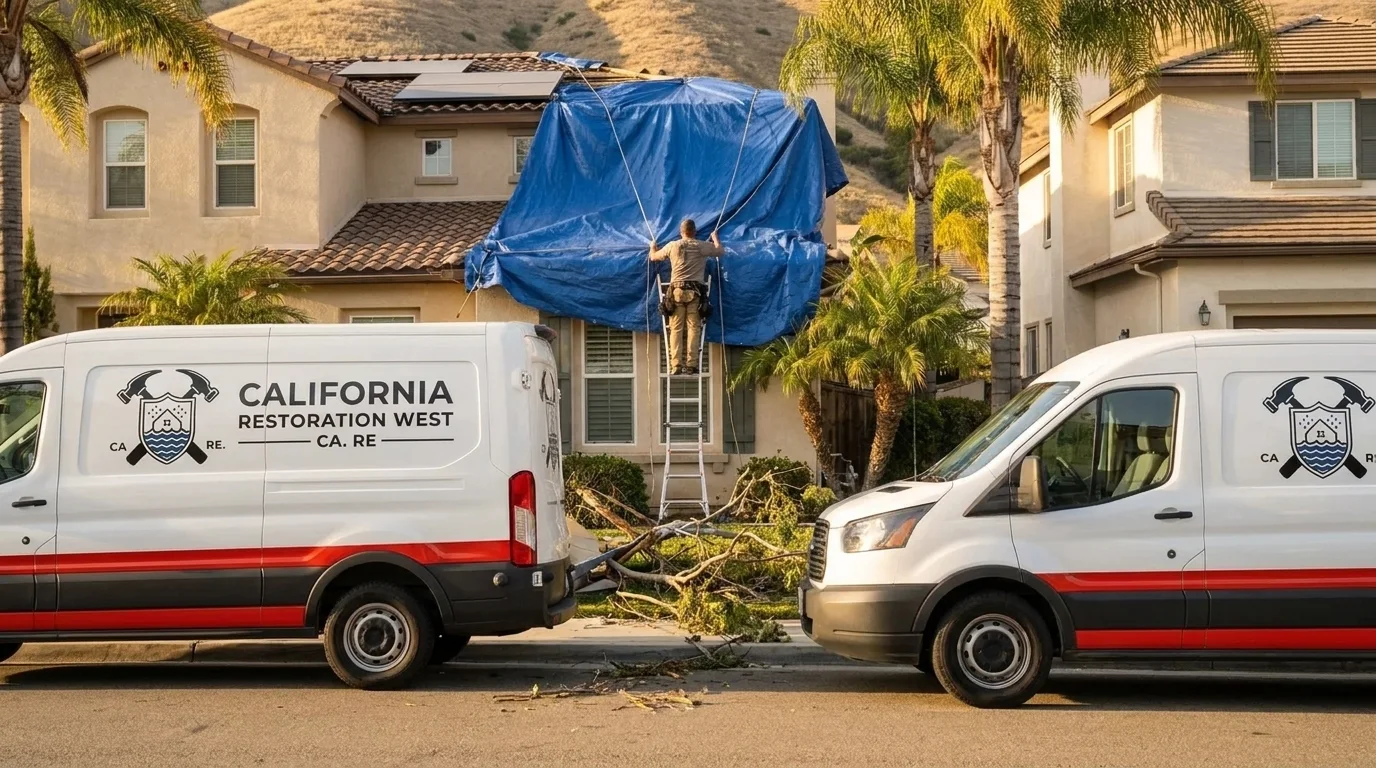
When we arrive on-site, the first priority is stopping active water entry. That means emergency tarping of breached roof sections, temporary board-up of broken windows or doors, and diverting any standing water away from the foundation. We document everything photographically before any material is moved, a step that matters when you’re filing with your carrier.
Once the structure is stabilized, we assess moisture migration using thermal imaging and calibrated moisture meters. Water that enters through a compromised roof or wall assembly doesn’t stay where it lands, it travels along framing members, pools in wall cavities, and wicks into subfloor sheathing. Our IICRC-certified technicians follow the S500 and S520 standards to map the full extent of saturation before any drying equipment is placed.
Structural drying in Thousand Oaks homes often requires careful attention to stucco wall assemblies. Unlike drywall, stucco systems trap moisture between the scratch coat and the framing, and surface readings can appear normal while the wood behind stays wet. We use penetrating probes and cavity drying equipment specifically for these assemblies, which are widespread in homes built during the valley’s primary growth decades.
Debris removal, broken branches, displaced roofing material, damaged fencing, is coordinated alongside the drying and repair phases so the property is accessible and safe throughout the process.
Reaching Thousand Oaks from Ventura
California Restoration West is based in Ventura, and Thousand Oaks is a direct run east on the 101 Freeway, a route our crews travel regularly. Because we operate 24/7, we can dispatch for storm emergencies at any hour, including during the overnight and early-morning window when many Pacific fronts make landfall and cause the most acute damage. Storm events that affect Thousand Oaks often affect the broader Conejo Valley simultaneously, so we coordinate crew deployment to prioritize the most time-sensitive calls, active water intrusion, structural compromise, and situations where a household cannot safely remain in the home.
Thousand Oaks Insurance Coordination
Storm damage claims in Ventura County tend to involve multiple damage categories on a single claim, wind damage to the roof, water intrusion through that breach, and sometimes tree removal costs on top of structural repairs. We document each damage category separately and provide your adjuster with a scope of loss that distinguishes between wind-caused damage and resulting water damage, which matters for how your policy applies coverage.
If your neighborhood has an HOA with architectural review requirements, common in many of Thousand Oaks’ planned communities, we can work within those guidelines for exterior repairs and help you understand what documentation the association typically requires before work begins.
Local Note
One pattern we see in Thousand Oaks that catches homeowners off guard: the valley’s clay-dominant soils expand significantly when saturated, and in homes with older concrete block or poured-concrete perimeter foundations, that soil pressure can force water through foundation cracks that were previously dormant. After a heavy storm, a wet garage slab or a damp utility room isn’t always a roof or plumbing problem, it can be hydrostatic pressure from the ground itself. If you’re seeing moisture at the base of interior walls or along the slab perimeter after a storm, that’s worth flagging to us when you call, so we bring the right assessment equipment on the first visit.
If storm damage has left your Thousand Oaks home with a compromised roof, standing water, or structural debris, call California Restoration West at (805) 290-7292. We’re available around the clock and can dispatch immediately to assess and stabilize your property before the next weather system arrives.
Serving Thousand Oaks from our Ventura headquarters — ★ 5.0 · 9 Google reviews
“Jimmy and his team were great to work with — professional, responsive, and did excellent work here in the Thousand Oaks/Conejo Valley area. Highly recommend them for anyone looking for reliable, quality service.” — Davis, November 2025Read our reviews on Google →
Storm Damage Restoration in Thousand Oaks: Service Coverage
Frequently Asked Questions
How fast can you arrive for storm damage restoration in Thousand Oaks?
How quickly can California Restoration West reach Thousand Oaks after a storm emergency?
Thousand Oaks has a lot of hillside homes — does slope affect how storm water intrusion is assessed?
Does the stucco construction common in Thousand Oaks change how storm water damage is dried?
My Thousand Oaks neighborhood has an HOA — will that complicate exterior storm repairs?
How does California Restoration West handle a storm damage insurance claim that involves both wind and water damage?
Storm Damage Restoration response in Thousand Oaks
Most Thousand Oaks calls see a technician on-site within 60 minutes from our Ventura headquarters.
Nearby & Related
- 24/7 Emergency Storm Damage Restoration in Ventura
- Restoration Services in Thousand Oaks
- Mold Remediation in Thousand Oaks
- 24/7 Emergency Water Damage Restoration in Thousand Oaks
- 24/7 Emergency Storm Damage Restoration in Camarillo
- 24/7 Emergency Storm Damage Restoration in Fillmore
- Contact California Restoration West